Table of Contents
Introduction
A 1400 calorie meal plan gives you a clear daily budget, which is exactly why so many beginners search for one. Instead of guessing what to eat, you get a simple structure: three meals, a snack, and a number you can actually track. This guide from The Daily Crave walks you through the full week with real menus and honest limits.
Here is what you will find. You will see who a 1400 calorie diet meal plan tends to suit and who should skip it, how to split your calories so you stay full, a higher-protein version, and a Sunday prep routine. If you want the bigger picture first, start with our weight loss meal plan pillar guide.
1. Is a 1400 Calorie Meal Plan Right for You?
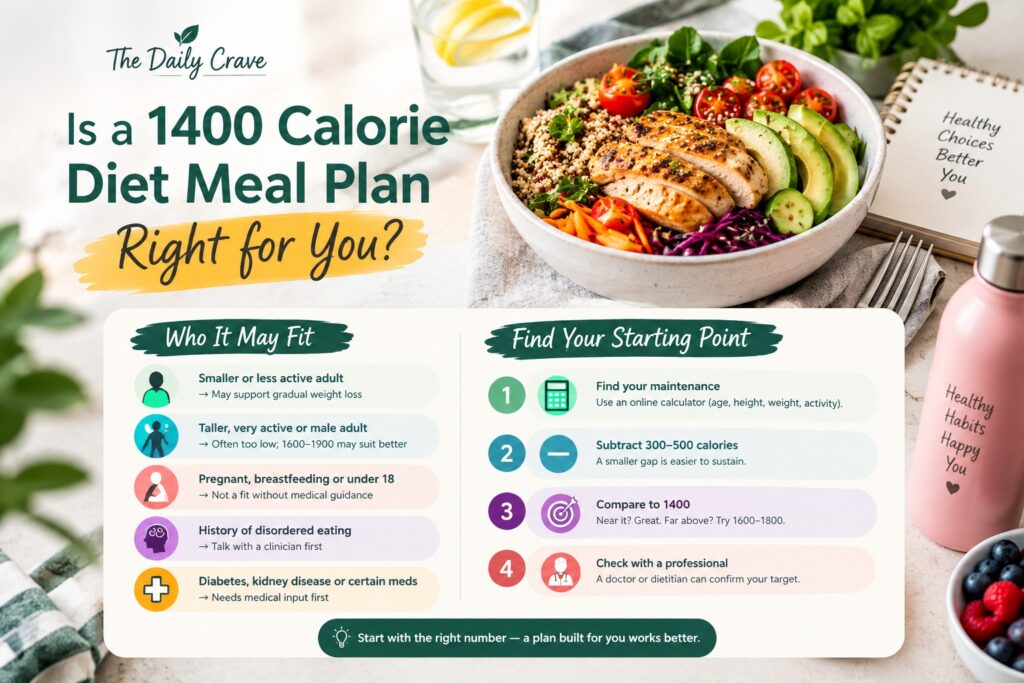
Calorie needs vary a lot from person to person, so the first job is checking whether this number fits your body. For some adults, 1400 Calorie Meal Plan sits comfortably below maintenance. For others, it is simply too little food.
| Your situation | How this plan may fit |
| Smaller or less active adult wanting gradual weight loss | May be a reasonable starting point |
| Taller, very active, or male adult | Often too low; 1600 to 1900 calories may suit better |
| Pregnant, breastfeeding, or under 18 | Not a fit without medical guidance |
| History of disordered eating | Talk with a clinician before counting calories |
| Diabetes, kidney disease, or medication that affects appetite or blood sugar | Needs medical input first |
Here is how to estimate your own starting point:
- Find your maintenance estimate. Use a reputable online calculator that factors in age, height, weight, and activity. Treat the result as an estimate, not a fact.
- Subtract a modest amount. A gap of roughly 300 to 500 calories a day is a common starting range, and smaller gaps tend to be easier to sustain for many people.
- Compare the result to 1400. If you land near it, this plan may fit. If you land far above it, a 1600 or 1800 calorie version may feel better.
- Check with a professional. A doctor or registered dietitian can confirm the target, especially if you have a health condition.
When I build a plan like this, I always start with step one. A menu built on the wrong number usually shows up as constant hunger by Day 3.
2. How to Build a 1400 Calorie Meal Plan That Keeps You Full

A budget of 1400 Calorie Meal Plan leaves little room for filler, so where the calories go matters. This is the split I use for every menu in this article.
| Meal | Calorie target | What it should include |
| Breakfast | About 300 | 20 to 25 g of protein plus fiber from oats, fruit, or whole grain toast |
| Lunch | About 400 | A palm-sized protein, plenty of vegetables, and one measured carb |
| Snack | About 250 | Protein plus fruit or vegetables; can be split into two mini snacks |
| Dinner | About 450 | Lean protein, two vegetables, and a small starch or healthy fat |
Five habits make the numbers easier to live with:
- Anchor every meal with protein. Research suggests protein may help you feel fuller for longer, which can make a smaller calorie budget feel more manageable.
- Fill half your plate with non-starchy vegetables. Salad greens, zucchini, peppers, and broccoli add volume for very few calories.
- Measure the calorie-dense extras. Olive oil is roughly 120 calories per tablespoon and nut butter about 95. I use a measuring spoon for the first two weeks, because eyeballing oil is where my own estimates drifted the most.
- Choose fiber-rich carbs. Beans, oats, quinoa, and fruit tend to keep you satisfied longer than refined options.
- Keep drinks simple. Water, unsweetened tea, and black coffee cost almost nothing, while sweet drinks can quietly use 150 to 250 calories.
3. The 7-Day 1400 Calorie Meal Plan for Weight Loss
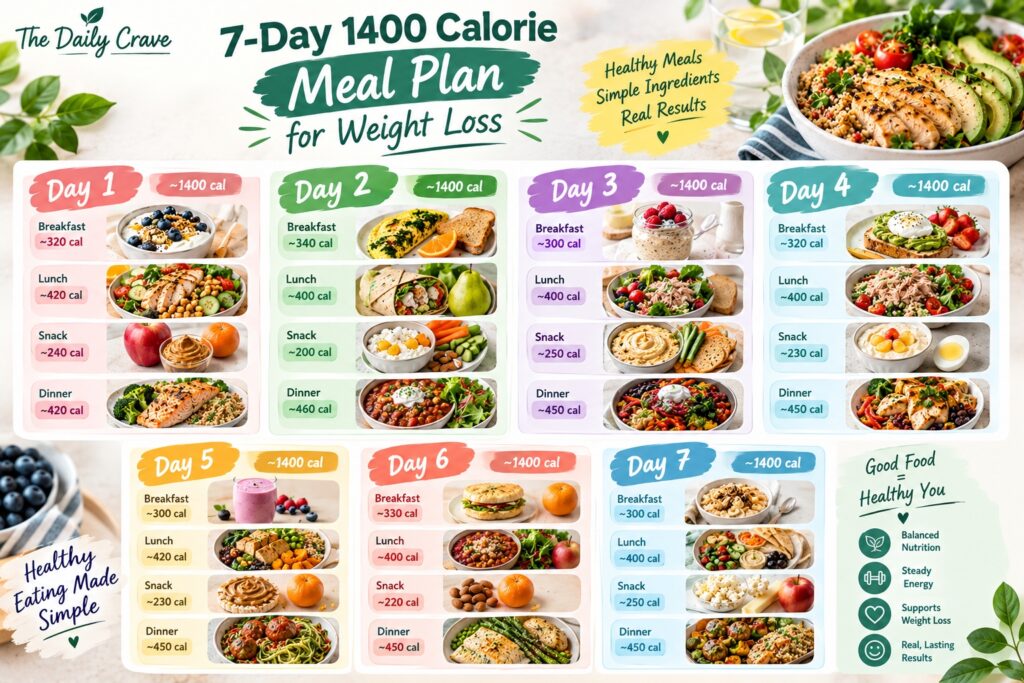
Each day below lands near 1400 Calorie Meal Plan. The numbers are estimates, so brands and portion sizes will shift them a little. Read labels and adjust if your portions differ.
Day 1: Yogurt Bowl, Chicken Salad, and Salmon
- Breakfast (about 320): 3/4 cup plain nonfat Greek yogurt, 1/2 cup blueberries, 1 tablespoon chia seeds, 1 tablespoon chopped walnuts, and a small drizzle of honey.
- Lunch (about 420): Grilled chicken and chickpea salad with 3.5 oz chicken, 1/2 cup chickpeas, cucumber, tomato, and 1 tablespoon olive oil with lemon.
- Snack (about 240): A small apple with 1 tablespoon peanut butter, plus a clementine.
- Dinner (about 420): 4 oz baked salmon, 1 cup roasted broccoli, and 1/2 cup cooked quinoa.
Start here because the meals are simple and the chicken and quinoa can be cooked ahead.
Day 2: Veggie Omelet, Turkey Wrap, and Chili
- Breakfast (about 340): Two-egg omelet with spinach and mushrooms cooked in 1 teaspoon olive oil, one slice of whole grain toast, and a small orange.
- Lunch (about 400): Whole wheat tortilla with 3 oz sliced turkey, 2 tablespoons hummus, lettuce, and cucumber, plus a medium pear.
- Snack (about 200): 1/2 cup low-fat cottage cheese with 1/2 cup pineapple and 10 almonds.
- Dinner (about 460): 1 1/2 cups turkey and bean chili topped with 2 tablespoons Greek yogurt, with a side salad.
Make the chili in a double batch. Half of it returns on Day 6.
Day 3: Overnight Oats, Lentil Soup, and Shrimp Stir-Fry
- Breakfast (about 300): 1/2 cup rolled oats soaked overnight in 3/4 cup unsweetened soy milk with 1 tablespoon chia seeds and 1/2 cup raspberries.
- Lunch (about 400): 1 1/2 cups lentil soup, one slice of whole grain bread, and a small side salad.
- Snack (about 250): 3 tablespoons hummus with carrot and cucumber sticks and about six whole grain crackers.
- Dinner (about 450): Stir-fry with 5 oz shrimp, 2 cups mixed vegetables, a teaspoon of sesame oil, and 3/4 cup cooked brown rice.
This is a lighter, plant-leaning day, and the soup also freezes well.
Day 4: Avocado Toast, Tuna Bowl, and Fajita Bowl
- Breakfast (about 320): One thick slice of whole grain toast with 1/4 mashed avocado and a poached egg, plus 1 cup strawberries.
- Lunch (about 400): One 5 oz can of tuna in water over arugula with 1/2 cup cannellini beans, cherry tomatoes, lemon, and 1 tablespoon olive oil.
- Snack (about 230): 3/4 cup plain Greek yogurt with cinnamon and sliced peaches, plus one hard-boiled egg.
- Dinner (about 450): Chicken fajita bowl with 4 oz chicken, sauteed peppers and onions, 1/2 cup black beans, a little rice, salsa, and Greek yogurt.
The tuna bowl needs no cooking, so it suits a busy midweek lunch.
Day 5: Smoothie, Tofu Power Bowl, and Meatballs
- Breakfast (about 300): Blend 1 cup unsweetened almond milk, one scoop of protein powder, 1 cup frozen berries, and 1 tablespoon peanut butter.
- Lunch (about 420): Baked tofu with 1/2 cup quinoa, roasted sweet potato, kale, edamame, and 1 tablespoon tahini dressing.
- Snack (about 230): Two rice cakes with 1 tablespoon almond butter and a clementine.
- Dinner (about 450): Four turkey meatballs with 1/2 cup marinara, 1/2 cup whole wheat pasta, zucchini noodles, and a small green salad.
Zucchini noodles stretch a small pasta portion without adding many calories.
Day 6: Egg Muffin, Leftover Chili, and Baked Cod
- Breakfast (about 330): A whole wheat English muffin with one egg, a slice of Swiss cheese, and spinach, plus an orange.
- Lunch (about 400): 1 cup of the Day 2 chili with a side salad and a small apple.
- Snack (about 220): 1 oz almonds and a clementine.
- Dinner (about 450): 5 oz baked cod with lemon and garlic, roasted asparagus, a small baked potato, and 1/2 cup peas.
Leftover day. Less cooking tends to make the middle of the week easier to follow.
Day 7: Oatmeal, Mediterranean Plate, and Sheet-Pan Chicken
- Breakfast (about 300): 1/2 cup oats cooked in water with a sliced small banana, 1 tablespoon walnuts, and cinnamon.
- Lunch (about 400): 3 oz grilled chicken, 3 tablespoons hummus, a small whole wheat pita, cucumber-tomato salad, and five olives.
- Snack (about 250): 3 cups air-popped popcorn, a string cheese, and a small apple.
- Dinner (about 450): 5 oz baked chicken breast with roasted Brussels sprouts, butternut squash, and 1/3 cup cooked farro.
For more flavor ideas, the Mediterranean meal plan pairs nicely with this day.
5 Healthy 1400 Calorie Meal Plan to Lose Weight: Lunch Ideas
Lunch is where many plans fall apart, so these five are built to be packed and eaten cold or reheated. Each one is about 400 calories.
- Turkey veggie wrap: whole-wheat tortilla, turkey, hummus, crunchy vegetables, and an apple on the side.
- Chicken quinoa bowl: cooked chicken, quinoa, roasted vegetables, and a light olive oil and lemon dressing.
- Tuna white bean salad: tuna, white beans, greens, tomatoes, and olive oil with lemon.
- Lentil soup and salad: a big bowl of lentil soup, a side salad, and one slice of whole-grain toast.
- Chickpea veggie bowl: chickpeas, brown rice, roasted vegetables, and a yogurt-tahini sauce.
4. 1400 Calorie Meal Plan High Protein: Simple Swaps
If you prefer a 1400 calorie meal plan high protein version, you do not need a new menu. A few swaps raise protein while keeping the total close to the same. Many versions of this plan land around 90 to 110 grams of protein a day, though your needs depend on your size and activity.
| Meal | Standard choice | Higher-protein swap | Why it helps |
| Breakfast | Oatmeal with banana | Oats stirred with a scoop of protein powder | Adds about 15 to 20 g protein |
| Lunch | Hummus wrap | Add extra turkey, skip some hummus | Trades fat calories for protein |
| Snack | Crackers and hummus | Cottage cheese with fruit | Roughly double the protein |
| Dinner | Pasta with meatballs | Extra meatballs, smaller pasta portion | Protein rises, starch falls |
Three reminders when you go this route:
- Do not drop vegetables. Protein-heavy plans can run low on fiber, so keep half your plate produce.
- Drink enough water. Many people find they need more fluid as protein and fiber intake go up.
- Check with your doctor if you have kidney concerns. Higher-protein eating is not appropriate for everyone.
5. A 90-Minute Sunday Prep Routine
These 1400 calorie meal plans work best when the cooking is done in one block. This routine covers most of the week.
| Task | Time | Covers |
| Cook quinoa, brown rice, and farro | 25 min | Days 1, 3, 4, 5, 7 |
| Grill or bake chicken breasts | 20 min | Days 1, 4, 7 |
| Simmer a double batch of turkey chili | 30 min | Days 2 and 6 |
| Hard-boil six eggs and wash produce | 15 min | Snacks and salads |
A few storage notes:
- Most cooked leftovers keep about 3 to 4 days in the fridge. Freeze the chili and soup for later in the week.
- Portion snacks in small containers. Pre-measured portions reduce the urge to graze.
- Keep sauces and dressings separate. Salads stay crisp until you eat them.
6. Why Diet Plans to Lose Weight Fast Often Backfire

It is tempting to search for diet plans to lose weight fast, but speed is rarely the helpful goal. Very large calorie cuts may leave you hungry, tired, and more likely to quit.
- A steady pace is easier to keep. Many people find a gradual rate easier to maintain than an aggressive one.
- Hunger can build over time. The longer you stay at a low target, the more likely you are to overeat later.
- Plan breaks. Some people use a 1400 Calorie Meal Plan for a few weeks, then return to maintenance for a while. A dietitian can help you decide what is right for you.
- Measure more than the scale. Energy, sleep, and how your clothes fit also tell you how things are going.
The goal is a routine you can follow, not a number you chase.
7. What to Do When Progress Slows

Bodies do not lose weight in a straight line. These adjustments may help when things stall.
| What you notice | A possible reason | What to try |
| Scale flat for 2 to 3 weeks | Portions creeping up | Measure oils and snacks again |
| Hungry all day | Too little protein or fiber | Add a protein source to each meal |
| Low energy or dizziness | Target may be too low | Add 100 to 200 calories and see a doctor if it continues |
| Late-night cravings | Dinner too small or too early | Move 100 calories from lunch to dinner |
If you feel unwell at any point, pause the plan and talk with a healthcare professional.
8. Key Takeaways
- A 1400 calorie meal plan may suit smaller or less active adults, but many people need more.
- Estimate your maintenance calories first, then pick a modest deficit.
- Split calories across meals and anchor each with protein and fiber.
- A 1400 calorie meal plan high protein version needs only a few swaps.
- One Sunday prep session can cover most of the week.
- Slow, steady progress tends to be easier to keep than fast results.
9. Frequently Asked Questions
Q1. Is 1400 Calorie Meal Plan enough to lose weight?
It depends on your maintenance needs. For many smaller or less active adults, 1400 Calorie Meal Planbmay create a deficit that supports gradual loss, but it can be too low for others.
Q2. How much weight can I expect to lose?
Results vary widely. A deficit of about 500 calories a day is often cited as roughly one pound per week, but real progress is rarely that tidy.
Q3. Can I follow this 1400 Calorie Meal Plan if I exercise?
Yes, light to moderate exercise may fit. If you train hard, you may need more food, so listen to your energy levels.
Q4. How long should I follow a 1400 calorie meal plan for weight loss?
There is no single answer. Many people reassess after a few weeks, and a doctor or dietitian can give guidance for your situation.
Q5. Can I swap meals between days?
Yes. Keep the calorie targets for each meal similar and the plan still works.
10. Conclusion
A 1400 calorie meal plan can give you a clear, workable structure when you match it to your needs. Start with an honest calorie estimate, build meals around protein and fiber, and prep a few staples so the week runs smoothly. Be patient with the pace, and adjust when your body asks for something different.
Ready for more? Explore the full Meal Plan and Weight Loss categories, or revisit our weight loss meal plan guide for the wider picture. You can find everything at thedailycrave.online.