Table of Contents
A 48 hour fast sits in a different category from the everyday intermittent fasting most people start with. It’s not a daily eating window or a calorie-restricted day , it’s two full consecutive days without food. For people who’ve built a solid foundation with methods like 16:8 or the 5:2 approach, extended fasting from 24 to 48 hours is a logical next step worth understanding. For beginners who’ve never fasted before, it’s worth knowing what you’re considering before you jump in.
Extended fasting , particularly anything in the 24 to 48 hours range , tends to generate a lot of questions. Will you lose muscle? Is it safe? What happens to your body hour by hour? What should you eat before you start, and how do you break the fast without feeling terrible afterward? These are all reasonable things to want answered before attempting something this significant.
This guide covers all of it. What a 48 hour fast actually does to your body, who it may suit, how to prepare, how to get through it, and the practical refeeding approach that makes the difference between feeling great afterward and feeling awful. Let’s walk through it clearly.
1. What Happens to Your Body During a 24 to 48 Hour Fast?
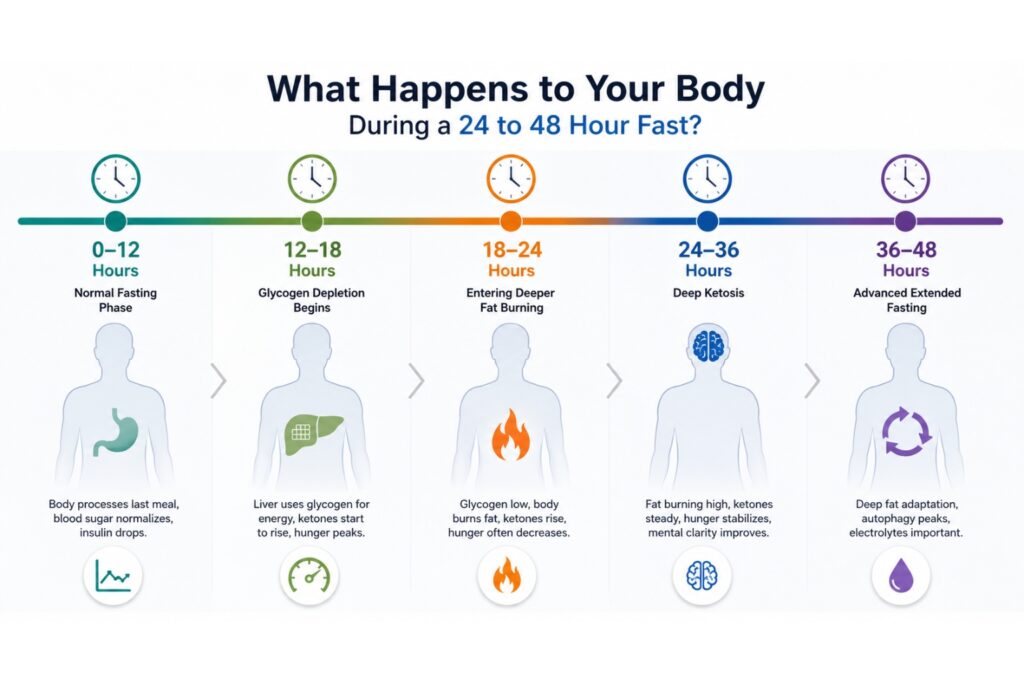
Understanding the timeline makes extended fasting feel less mysterious. Here’s roughly what happens inside your body as the hours progress during a 24 to 48 hour fasting period.
Hours 0–12: Normal Fasting Phase
Your body processes the last meal, blood sugar returns to baseline, and insulin drops. This is the same territory covered by an overnight fast. Nothing dramatic yet.
Hours 12–18: Glycogen Depletion Begins
Blood glucose continues to decline. Your liver starts drawing on glycogen stores (your body’s stored carbohydrate) for energy. Ketone production begins to ramp up. Many people experience mild hunger during this window , often the strongest hunger of the entire fast.
Hours 18–24: Entering Deeper Fat Burning
By the time you reach the 24 hour fast mark, glycogen stores are significantly depleted. Your body is increasingly reliant on fat oxidation for energy. Ketone levels are measurably elevated. Some people report reduced hunger at this point , a common observation once the body adjusts to running on fat.
Autophagy , the cellular process where the body identifies and recycles damaged cell components , is believed to increase during this phase, though the precise timeline varies between individuals and is still being studied.
Hours 24–36: Deep Ketosis
You’re now in what many fasting practitioners consider the “productive” zone. Fat burning is elevated, ketone production is meaningful, and hunger often stabilizes or decreases further. Mental clarity improves for many people at this stage, though some experience brain fog initially as the transition occurs.
Hours 36–48: Advanced Extended Fasting
Approaching a full 48 hour fast, your body is deeply fat-adapted for the duration. Autophagy is theorized to be at its highest, and the metabolic shift is substantial. Electrolyte management becomes increasingly important in this window. This territory requires more preparation and carries more risk for people with underlying health conditions , which is why medical guidance is particularly important for anything in this range.
2. What Does a 48 Hour Fast Do for Weight Loss?
This is usually the first practical question: does a 48 hour fast weight loss effect actually translate to meaningful results?
The short answer is yes , with some important context.
Water Weight vs. Fat Loss
A significant portion of the weight lost during a 48 hour fast is water weight. As glycogen depletes, the water stored alongside it (roughly 3–4g of water per gram of glycogen) is released. This can mean 2–4 lbs on the scale , real, but not primarily fat.
Actual fat loss during extended fasting depends on your individual metabolic rate. Research suggests that fasting increases fat oxidation, and a 48-hour period of significantly reduced calorie intake creates a meaningful caloric deficit. For someone with a TDEE of 2,000 calories, two days of no food represents approximately a 4,000-calorie deficit , which, if real fat loss is the goal, is substantial.
The Muscle Question
One legitimate concern about extended fasting is muscle loss. Research suggests that short-term fasting , particularly in the 24 to 48 hours range , does not cause significant muscle breakdown in otherwise healthy people, especially if protein intake was adequate in the days before the fast. Human growth hormone (HGH) actually increases during fasting, which may help protect lean tissue.
That said, extended fasting combined with regular intense exercise requires careful management, and those with very low body fat or specific athletic performance needs should approach this thoughtfully.
3. Who Might Benefit from a 48 Hour Fast , And Who Shouldn’t Try It
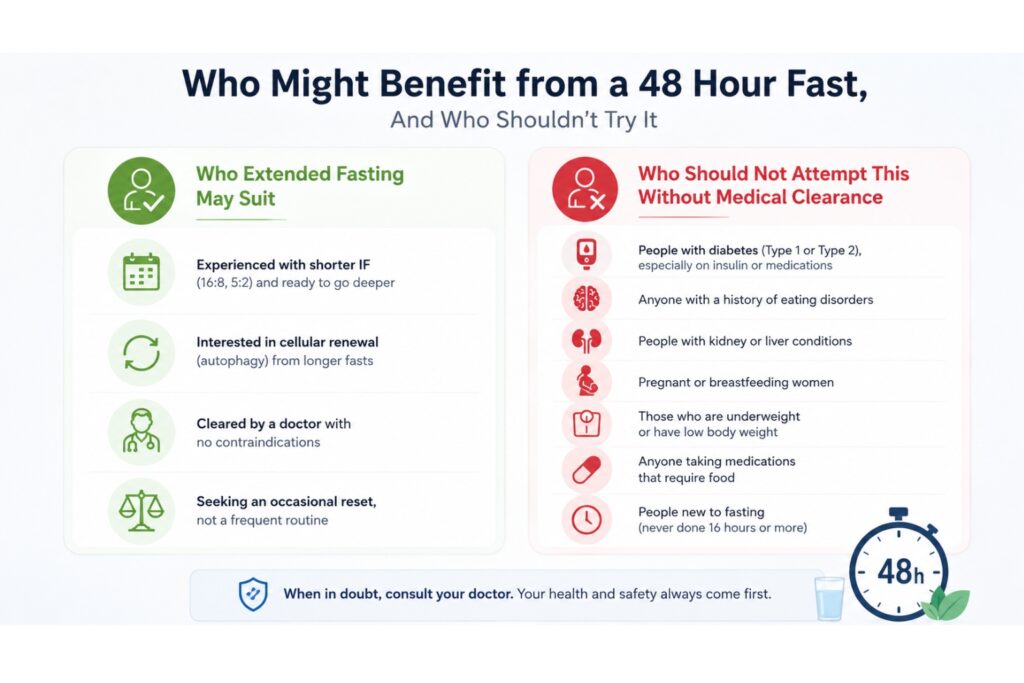
Extended fasting isn’t for everyone. Being clear about both sides of this is genuinely important.
Who Extended Fasting May Suit
- People experienced with shorter IF methods (16:8, 5:2) who want to explore deeper fasting
- Those interested in the cellular renewal effects (autophagy) associated with longer fasting periods
- People who have consulted their doctor and have no contraindications
- Those looking for an occasional “reset” rather than a daily or weekly protocol
Who Should Not Attempt This Without Medical Clearance
- People with type 1 or type 2 diabetes (especially on insulin or blood sugar medications)
- Anyone with a history of eating disorders
- People with kidney or liver conditions
- Pregnant or breastfeeding women
- Those with low body weight or who are underweight
- Anyone currently taking medications that require food intake
- People new to fasting who have never done even a 16-hour fast
If you’re in any of these categories, this isn’t the place to start. A shorter, gentler fasting diet plan , like 16:8 , is a far more appropriate beginning point.
4. How to Prepare for a 48 Hour Fast
Preparation makes an enormous difference in how a 48 hour fast goes. Jumping in without preparation is one of the most common reasons people abandon extended fasts early and feel terrible afterward.
The Day Before: What to Eat
The meal before your fast begins matters more than most people realize. Aim for:
- A protein-rich meal: Chicken, fish, eggs, or legumes. Protein is slower to digest and provides sustained satiety into the early fasting hours.
- Complex carbohydrates: Brown rice, sweet potato, oats, or quinoa. These fill glycogen stores and provide more sustained energy early in the fast.
- Healthy fats: Avocado, olive oil, or fatty fish. Fat slows gastric emptying and helps you start the fast feeling genuinely satisfied.
- Vegetables: A large serving of fiber-rich vegetables extends satiety further.
What to avoid the day before: Alcohol, heavily processed or fried food, and very large quantities of refined sugar. These can make the early fasting hours harder and increase nausea risk.
Hydration: Start Early
Don’t wait until the fast begins to focus on hydration. Drink 2–3 liters of water the day before. Starting the fast well-hydrated makes a measurable difference in how manageable the first 12–18 hours feel.
Electrolytes: The Most Overlooked Preparation Step
Sodium, potassium, and magnesium are lost more rapidly during fasting. Planning your electrolyte strategy before you start , rather than reaching for supplements mid-fast when you feel awful , is the approach of anyone who’s done this more than once.
Options during the fast:
- Water with a small pinch of Himalayan or sea salt
- Sodium and electrolyte tablets (no sugar, no calories)
- Magnesium glycinate supplement
- Potassium through salt substitutes (like No-Salt, a small amount)
5. Getting Through a 48 Hour Fast: Hour by Hour
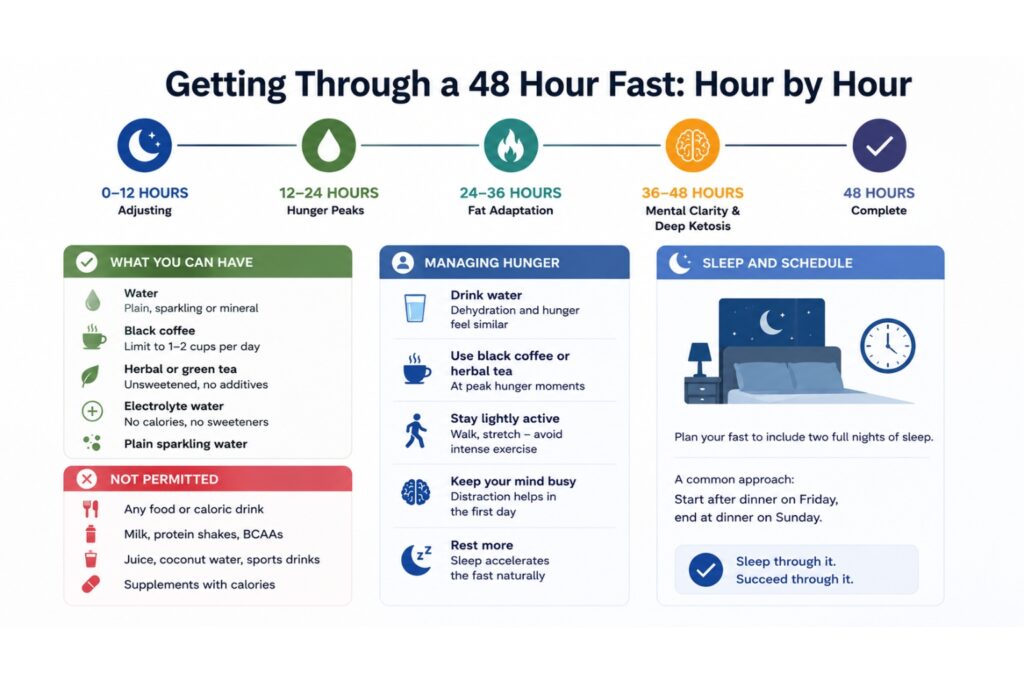
Here’s a practical framework for the 48 hours themselves.
What You Can Have During the Fast
Allowed (generally considered non-food and not breaking the fast):
- Water , plain, sparkling, or mineral; drink consistently throughout
- Black coffee , limit to 1–2 cups per day; can help with hunger and mental clarity
- Plain herbal or green tea , unsweetened, no milk or additives
- Electrolyte water or supplements (no calories, no sweeteners)
- Plain sparkling water
Not permitted (breaks the fast):
- Any food, regardless of calorie content
- Milk, cream, or any addition to coffee
- Protein shakes, BCAAs, or supplements with calories
- Fruit juice, coconut water, or sports drinks
Managing Hunger
Hunger during a 48 hour fast is typically strongest in the first 18–24 hours, then often decreases as ketone production increases. Common strategies for managing hunger waves:
- Drink a large glass of water immediately when hunger hits , dehydration and hunger feel similar
- Black coffee or herbal tea at peak hunger moments
- Light activity (walking, gentle stretching) , not intense exercise, which is poorly tolerated during extended fasting
- Keep yourself mentally occupied, particularly in the first day
- Rest more than usual , sleep accelerates the fast naturally
Sleep and Schedule
Planning your 48 hour fast so that two nights of sleep fall within it is genuinely helpful. Sleeping through 14–16 hours of the fast means far fewer conscious hours to manage. A common approach: begin the fast after dinner on Friday, and end it at dinner on Sunday , sleeping through Saturday and Sunday night within the fasting window.
6. The Refeeding Meal: How to Break a 48 Hour Fast
This is one of the most practically important sections of any 48 hour fast guide. Breaking an extended fast incorrectly can cause significant discomfort , bloating, nausea, cramping, and in extreme cases more serious gastrointestinal distress.
Why Refeeding Carefully Matters
After 48 hours without food, your digestive system has been largely at rest. Digestive enzyme production has slowed. Introducing a large, complex meal immediately can overwhelm a system that needs time to ramp back up. This is particularly true for high-fat or very high-fiber meals immediately after breaking the fast.
The Best First Meal After a 48 Hour Fast
Start small. Start simple. Start with protein.
Ideal refeeding meal (first 30–60 minutes after breaking the fast):
- 1–2 soft-boiled or scrambled eggs
- A small bowl of bone broth or miso soup
- A few slices of cucumber or soft steamed vegetables
- Small amount of plain Greek yogurt
This amounts to 200–300 calories of gentle, protein-forward food. Wait 30–60 minutes after this before eating more.
The Full Refeeding Day
Think of the day after a 48 hour fast as a “half-refeeding” day , not a return to completely normal eating.
Morning (break fast): Small protein and broth meal as above Mid-morning: Light smoothie or soft fruit with some yogurt Lunch: Lean protein (chicken, fish, eggs) + easily digestible vegetables + small amount of rice or oats Afternoon: Small snack if genuinely hungry Dinner: Normal, balanced meal , but still moderate in portion
Avoid: heavy fried food, very large meals, alcohol, and extremely high-fiber foods on the refeeding day. Your digestive system will thank you.
7. A Sample Week Using a 48 Hour Fast
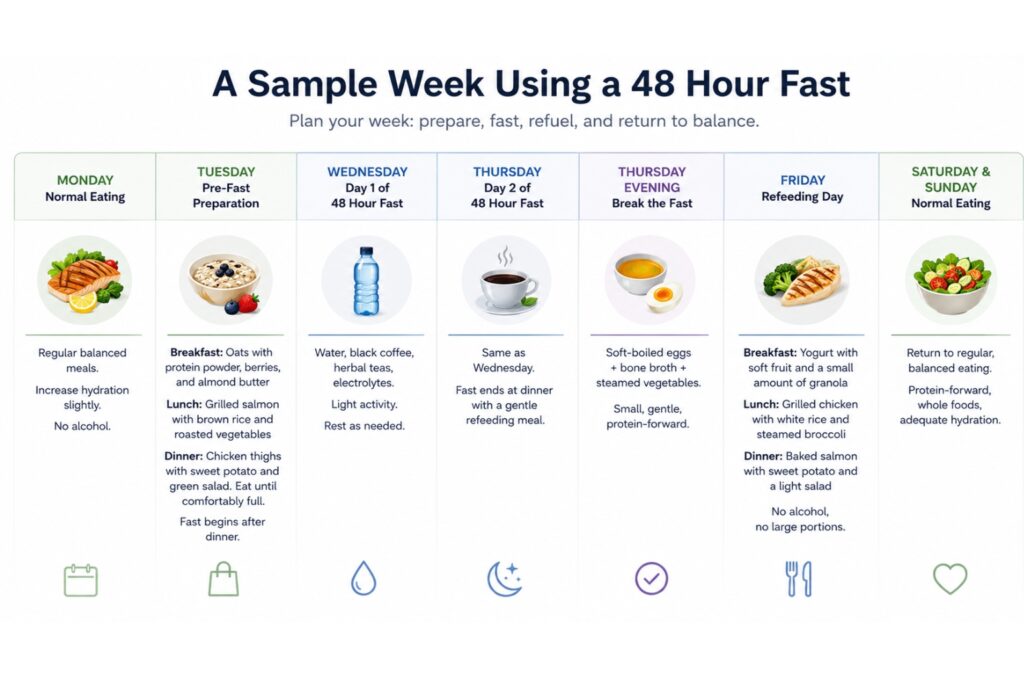
Here’s how a fasting diet plan might look for the week around a 48-hour fast , from preparation through refeeding and normal eating.
Monday , Normal Eating Regular balanced meals. Increase hydration slightly. No alcohol.
Tuesday , Pre-Fast Preparation Day
- Breakfast: Oats with protein powder, berries, and almond butter
- Lunch: Grilled salmon with brown rice and roasted vegetables
- Dinner (last meal before fast begins): Large protein-forward meal , chicken thighs with sweet potato and green salad. Eat until comfortably full. Fast begins after dinner.
Wednesday , Day 1 of 48 Hour Fast Water, black coffee, herbal teas, electrolytes. Light activity. Rest as needed.
Thursday , Day 2 of 48 Hour Fast Same as Wednesday. Fast ends at dinner with a gentle refeeding meal.
Thursday Evening , Break the Fast Soft-boiled eggs + bone broth + steamed vegetables. Small, gentle, protein-forward.
Friday , Refeeding Day
- Breakfast: Yogurt with soft fruit and a small amount of granola
- Lunch: Grilled chicken with white rice and steamed broccoli
- Dinner: Baked salmon with sweet potato and a light salad
- No alcohol, no very large portions
Saturday and Sunday , Normal Eating Return to regular, balanced eating. Protein-forward, whole foods, adequate hydration.
Key Takeaways
- A 48 hour fast involves going without food for two full consecutive days, consuming only water, black coffee, plain tea, and electrolytes
- Extended fasting of 24 to 48 hours may support fat oxidation, cellular repair processes like autophagy, and metabolic health , though individual responses vary
- Preparation matters: the meal before the fast, hydration levels, and electrolyte planning all significantly affect the experience
- Hunger is typically strongest in the first 18–24 hours of a 24 hour fast or longer, and often decreases as ketone production increases
- Breaking the fast gently , starting with small, easily digestible protein-forward foods rather than a large meal , prevents digestive discomfort
- A 48 hour fast weight loss effect includes water weight loss initially, with fat loss depending on overall caloric deficit and metabolic factors
- Extended fasting is not appropriate as a starting point , build experience with shorter fasting diet plan approaches (16:8, 5:2) first
- Medical consultation is strongly recommended before attempting extended fasting, particularly for anyone with health conditions or on medication
Conclusion: Is a 48 Hour Fast Right for You?
A 48 hour fast isn’t something to take lightly or attempt without preparation , but for experienced fasters in good health who approach it thoughtfully, it can be a meaningful addition to a broader health and wellness strategy. The key is preparation, electrolytes, a gentle refeeding approach, and honest self-assessment about whether you’re truly ready for this level of extended fasting.
If you’re newer to fasting and haven’t yet established a consistent shorter protocol, that’s the far better place to start. A structured fasting diet plan beginning with 16:8 or 5:2 builds the physiological and psychological foundation that makes longer fasting periods much more manageable when you eventually try them.
For a comprehensive look at every fasting method , from the beginner-friendly to the advanced , visit: Intermittent Fasting Meal Plan: The Complete Beginner’s Guide
Explore more free guides, meal plans, and practical nutrition content at thedailycrave.online.
Frequently Asked Questions (FAQ)
Q1: Is a 48 hour fast safe for most people?
A 48 hour fast may be safe for healthy adults who have prior fasting experience, good baseline nutrition, and no underlying health conditions. It is not considered safe without medical guidance for people with diabetes, a history of eating disorders, kidney or liver conditions, low body weight, pregnancy, or those on medications requiring food. Anyone in these categories should speak to a doctor before attempting extended fasting.
Q2: How much weight might I lose on a 48 hour fast?
48 hour fast weight loss results vary considerably. Many people see 2–4 lbs on the scale immediately after, though a meaningful portion of this is water weight from glycogen depletion rather than fat. Actual fat loss depends on individual metabolic rate and the caloric deficit created. The scale will typically rebound 1–2 lbs within a day or two of normal eating as glycogen and water return.
Q3: What can I drink during a 24 to 48 hour fast?
During a 24 to 48 hour fast, you can have plain water (still or sparkling), black coffee (1–2 cups daily), unsweetened herbal or green tea, and electrolyte supplements or water with a small pinch of salt. Nothing with calories , including milk, sweeteners, protein shakes, or juice , as these break the fast.
Q4: Will I lose muscle during a 48 hour fast?
Short-term fasting research generally suggests that muscle loss during a 48 hour fast is minimal in healthy individuals with adequate protein intake leading up to the fast. Human growth hormone increases during fasting, which may help protect lean tissue. That said, combining extended fasting with intense exercise on fasting days is not recommended and may increase the risk of muscle catabolism.
Q5: How do I break a 48 hour fast without feeling sick?
The key to breaking a 48 hour fast comfortably is starting small and gentle. Begin with 1–2 soft-boiled or scrambled eggs, a small bowl of bone broth, or a modest amount of Greek yogurt. Wait 30–60 minutes before eating more. Avoid immediately returning to large, high-fat, high-fiber, or fried meals , these can cause significant nausea and bloating after extended fasting. Treat the rest of the day as a gentle refeeding day before returning to normal eating.