Table of Contents
Eat Stop Eat is one of the more distinctive approaches to intermittent fasting , and one of the most frequently misunderstood. Created by nutrition researcher Brad Pilon, it’s built on a deceptively simple idea: fast for a full 24 hours, once or twice a week, and eat normally the rest of the time. No daily eating windows, no calorie counting on regular days, and no elimination of any particular food group. Just one or two intentional 24-hour fasts per week.
If that sounds more manageable than restricting food every single day, you’re not alone in thinking so. The appeal of Eat Stop Eat
is exactly that flexibility , five or six completely normal eating days in exchange for one or two structured fasting days. For people who find daily restriction mentally exhausting but can commit to a weekly 24-hour reset, this approach has real psychological appeal.
But is it actually effective? How does it work in practice? And how does it compare to other fasting approaches? This review covers everything: the core method, the evidence behind it, a sample weekly structure, and honest practical advice for anyone considering giving it a try.
1. What Is Eat Stop Eat?
Eat Stop Eat is a book and fasting protocol developed by Brad Pilon, a former sports supplement researcher who turned his academic curiosity about fasting into a practical eating approach. The method has been around since 2007 and has influenced a significant part of how the mainstream fasting conversation developed.
The core premise of the Eat Stop Eat diet is this:
- Fast for 24 hours, one or two times per week
- Eat normally , without calorie counting or food restriction , on all other days
- The 24-hour fast can run from any meal to the same meal the next day (dinner-to-dinner, breakfast-to-breakfast, etc.)
That’s essentially the complete protocol. There are no approved or banned foods, no specific macros to hit, and no complicated phase structure. The simplicity is deliberate , Pilon’s argument is that the 24-hour fast itself creates the calorie deficit and metabolic effects, while the freedom on regular days makes the overall approach more sustainable long-term.
How the 24-Hour Window Works in Practice
A common implementation: you eat a normal dinner on Monday at 7pm. You don’t eat again until 7pm on Tuesday. You’ve completed a 24 hour fast. On Wednesday, you eat normally again. The following week, you might fast Thursday dinner to Friday dinner.
The flexibility here is real. Unlike time-restricted eating (16:8), the Eat Stop Eat approach doesn’t lock you into the same daily schedule. You choose which days work for your week, you choose which meal-to-meal window fits your schedule, and you adjust from week to week based on what’s happening socially and professionally.
2. The Science Behind Eat Stop Eat
Brad Pilon grounded the Eat Stop Eat method in research on fasting physiology, and the science he draws on is legitimate , even if the extrapolations to specific outcomes require the same epistemic caution as any diet claim.
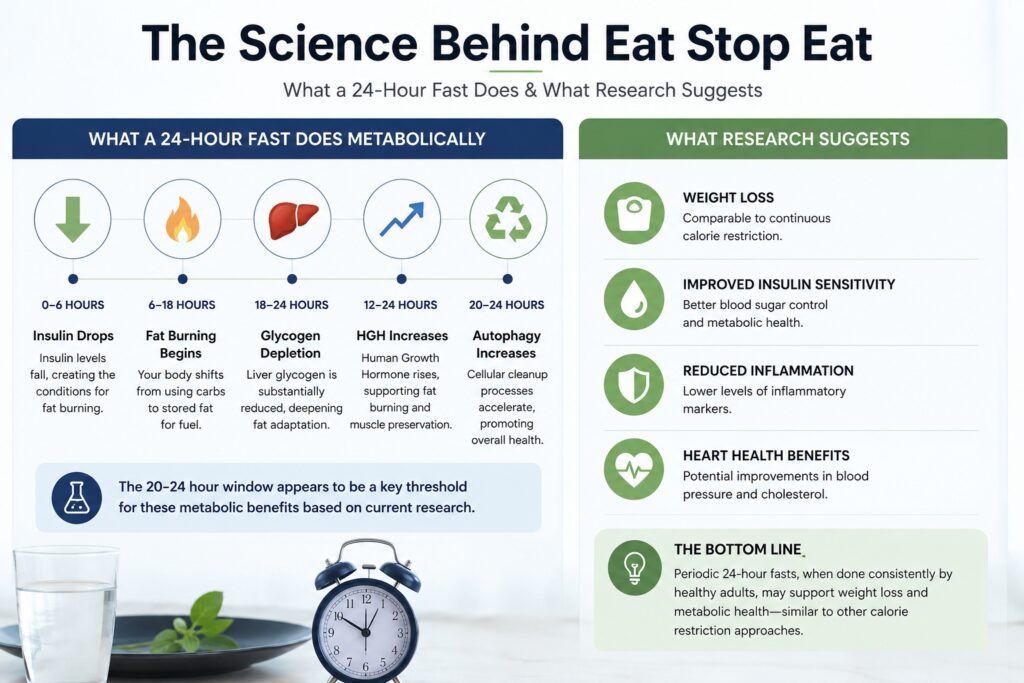
What a 24-Hour Fast Does Metabolically
During a 24 hour fast, several things happen in sequence:
Insulin drops significantly. Without food intake, blood glucose declines and insulin follows. Lower insulin creates the metabolic environment for fat oxidation , your body shifts toward burning stored fat rather than dietary carbohydrates for fuel.
Glycogen depletion progresses. By hour 18–24, liver glycogen is substantially reduced. This is the same depletion that takes longer to achieve on a daily 16:8 protocol.
Human Growth Hormone (HGH) increases. Fasting studies consistently show elevated HGH during extended fasting. HGH supports fat burning and is associated with muscle tissue preservation , which addresses one of the most common concerns about fasting protocols generally.
Autophagy increases. Cellular cleanup processes (autophagy) are believed to accelerate during extended fasting. Exactly how much and at what precise threshold is still being studied, but the 20–24 hour range appears to be meaningful territory based on current research.
The Health Benefits of Intermittent Fasting: What Research Suggests
The broader body of research on the health benefits of intermittent fasting , of which the Eat Stop Eat approach is one method , includes findings on weight loss comparable to continuous calorie restriction, improvements in insulin sensitivity, reductions in inflammatory markers, and potential cardiovascular benefits.
It’s worth noting that most fasting research uses different protocols (alternate day fasting, 16:8, 5:2) rather than the specific Eat Stop Eat diet design. Pilon draws on this broader fasting literature rather than studies testing his exact protocol , something worth knowing when evaluating specific outcome claims.
What the evidence does support reasonably well: that periodic 24-hour fasting, when practiced consistently by healthy adults, may contribute to weight loss and metabolic improvements comparable to other calorie restriction approaches.
3. Eat Stop Eat vs. Other Fasting Methods
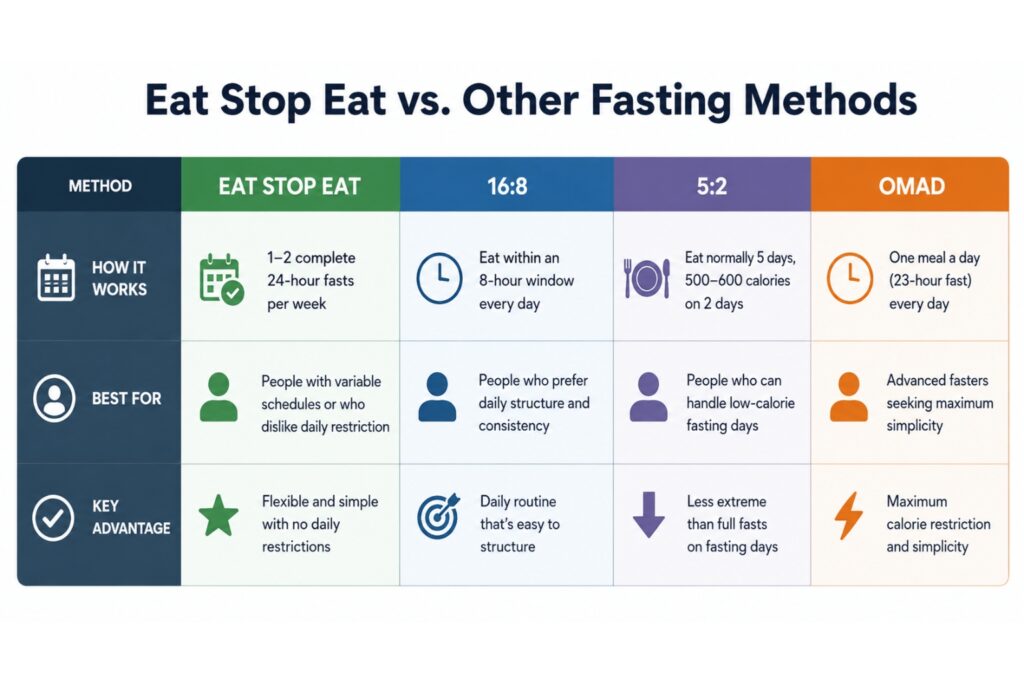
One of the most useful ways to understand Eat Stop Eat is to compare it to the fasting approaches most people have already heard of.
Eat Stop Eat vs. 16:8
16:8 compresses every day’s eating into an 8-hour window. It requires daily consistency , the same window, every day. Eat Stop Eat uses full 24-hour fasts one or two times per week, with no daily window on other days.
For daily structure people: 16:8 may suit better. For people with variable schedules or who dislike daily restriction: Eat Stop Eat offers more flexibility.
Eat Stop Eat vs. 5:2
The 5:2 diet also uses a weekly fasting structure , but instead of complete 24-hour fasts, it allows 500–600 calories on fasting days. Eat Stop Eat is more strict on fasting days (true 24-hour water fast) but has no calorie restriction whatsoever on non-fasting days.
People who find 500-calorie days manageable but complete fasting difficult may prefer 5:2. People who find eating a small amount more frustrating than eating nothing may prefer Eat Stop Eat.
Eat Stop Eat vs. OMAD
OMAD (One Meal a Day) involves a 23-hour fast daily , much more intensive than Eat Stop Eat‘s 1–2 weekly fasts. Eat Stop Eat is considerably more approachable for most people.
4. A Sample Week on the Eat Stop Eat Diet
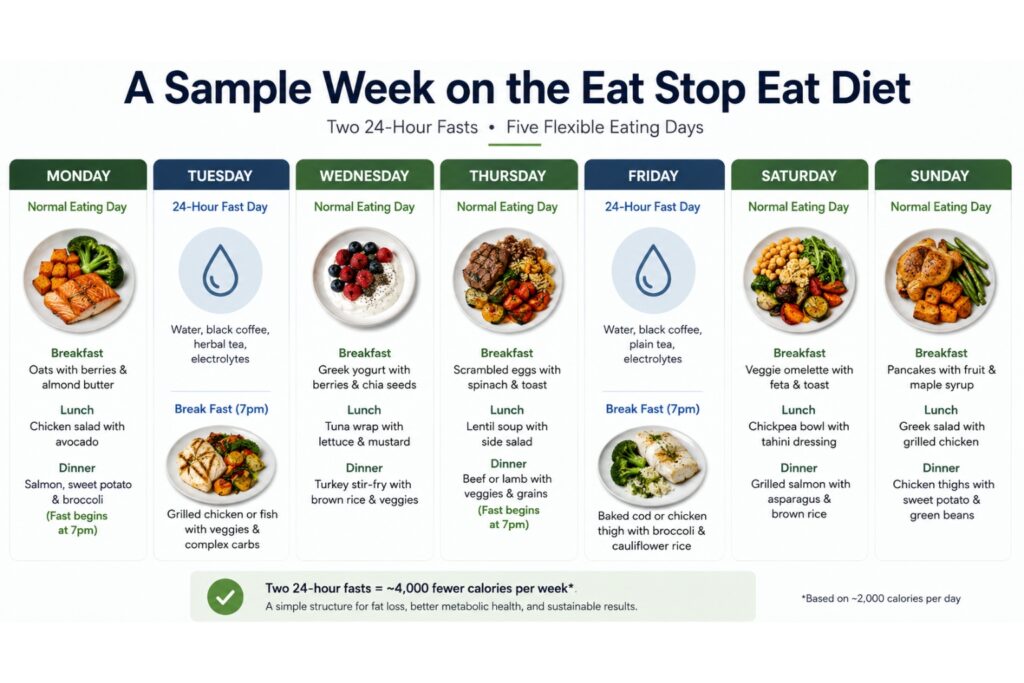
Here’s what a practical week on the Eat Stop Eat diet might look like, using two fasting days (Monday dinner to Tuesday dinner, and Thursday dinner to Friday dinner).
Monday , Normal Eating Day
- Breakfast: Oats with berries and a tbsp of almond butter
- Lunch: Grilled chicken salad with avocado, cucumber, and olive oil dressing
- Dinner (last meal before fast begins at 7pm): Salmon with roasted sweet potato and steamed broccoli. Eat a satisfying, protein-forward meal. Fast begins after this meal.
Tuesday , 24-Hour Fast Day
Water, black coffee, plain herbal tea, and electrolytes throughout the day. No food until dinner at 7pm.
Breaking the fast at 7pm: Start with a moderate-sized, protein-forward meal. Don’t use the first post-fast meal as an opportunity to compensate for the previous 24 hours , this is one of the most common mistakes and tends to undo the calorie deficit the fast created.
- First post-fast meal: Grilled chicken or fish with vegetables and a modest portion of complex carbohydrates (rice, sweet potato, quinoa)
Wednesday , Normal Eating Day
- Breakfast: Greek yogurt with mixed berries and chia seeds
- Lunch: Tuna salad wrap with whole-grain tortilla, lettuce, and mustard
- Dinner: Ground turkey stir-fry with brown rice and mixed vegetables
Thursday , Normal Eating Day (Fast begins after dinner)
- Breakfast: Scrambled eggs with spinach and whole-grain toast
- Lunch: Lentil soup with a side salad
- Dinner (last meal before second fast): Beef or lamb with roasted vegetables and a small serving of grains. Fast begins after this meal at 7pm.
Friday , 24-Hour Fast Day
Water, black coffee, plain tea, electrolytes. No food until dinner at 7pm.
Breaking the fast at 7pm: Same principle as Tuesday , moderate, protein-forward, no compensatory overeating.
- First post-fast meal: Baked cod or chicken thigh with steamed broccoli and cauliflower rice
Saturday , Normal Eating Day
- Breakfast: Veggie omelette with feta and whole-grain toast
- Lunch: Chickpea bowl with roasted vegetables and tahini dressing
- Dinner: Grilled salmon with asparagus and brown rice
Sunday , Normal Eating Day
- Breakfast: Whole-grain pancakes with fresh fruit and a small amount of maple syrup
- Lunch: Large Greek salad with grilled chicken
- Dinner: Roasted chicken thighs with sweet potato and green beans
This weekly structure provides two genuine 24-hour fasting periods while leaving five completely flexible days. The total calorie reduction from two 24-hour fasts (assuming roughly 2,000 calories per day for reference) represents approximately 4,000 calories per week , a meaningful deficit even if regular eating days are slightly above average.
5. What to Eat on Eat Stop Eat Non-Fasting Days
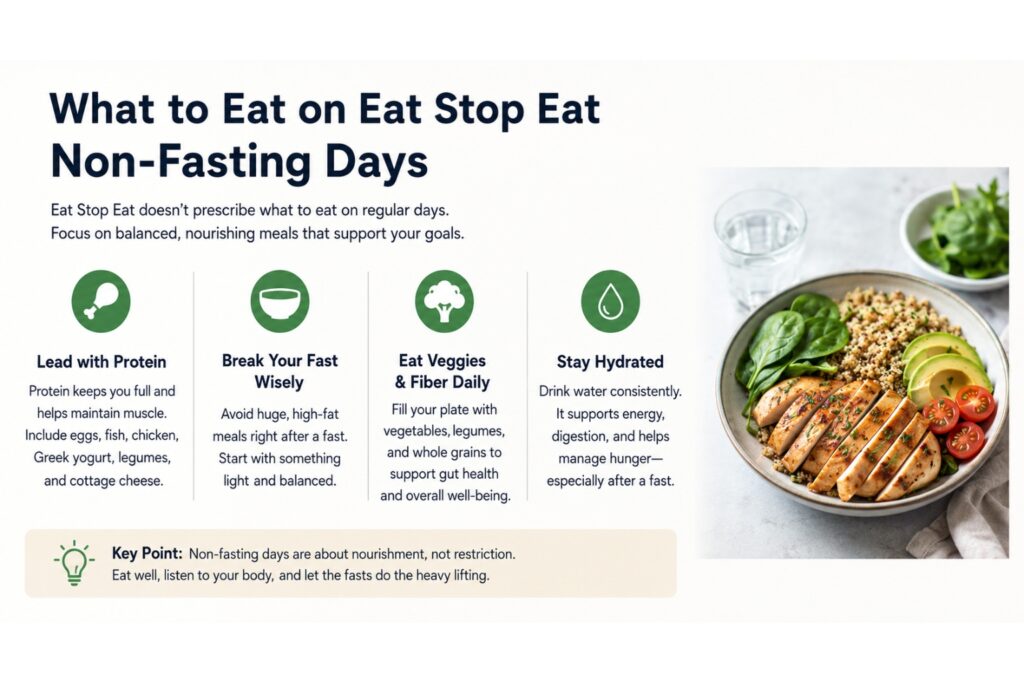
This is where the Eat Stop Eat approach differs most sharply from conventional diets: Pilon explicitly does not prescribe what to eat on regular days. The assumption is that removing 24 hours of food intake one or two times per week creates sufficient calorie reduction without requiring ongoing restriction.
In practice, this works well when regular eating days are reasonably balanced. It works less well when non-fasting days become an extended compensation for the fasting days , something to be genuinely mindful of.
Practical Non-Fasting Day Guidance
You don’t need to count calories. But a few principles help the Eat Stop Eat approach produce its intended results:
Lead with protein at every meal. Protein supports satiety and muscle preservation , particularly important when incorporating regular 24-hour fasts. Eggs, fish, chicken, Greek yogurt, legumes, and cottage cheese should feature prominently.
Don’t make the first post-fast meal a free-for-all. The meal that breaks your fast matters. Eating a very large, high-calorie, high-fat meal immediately after a 24-hour fast tends to cause digestive discomfort and undermines the calorie deficit the fast created.
Include vegetables and fiber daily. Non-fasting days are the time to load up on vegetables, legumes, and whole grains. These provide the micronutrients and fiber that support gut health , especially important when two days per week involve no food intake.
Stay hydrated consistently. Including on non-fasting days. Water intake matters for energy, digestion, and managing hunger , which can be elevated on the days immediately following a fast.
6. Honest Eat Stop Eat Review: What Works and What to Watch For
After covering the method and the evidence, an honest Eat Stop Eat review requires acknowledging both what the approach does well and where it may fall short.
What Works Well
Simplicity. The protocol has essentially one rule , fast for 24 hours, 1–2 times per week. There’s no food tracking, no macro counting, and no forbidden foods. For people overwhelmed by complex diet rules, this is genuinely appealing.
Flexibility. You choose which days and which meal-to-meal windows work for your week. This adaptability makes it more realistic for people with variable schedules than daily time-restricted eating.
Psychological sustainability. Many people find complete fasting for 24 hours easier than eating 500 calories , because eating a small amount can intensify hunger rather than satisfying it. Eat Stop Eat sidesteps this by using complete 24-hour fasts rather than partial restriction.
Calorie reduction without ongoing tracking. Two 24-hour fasts per week create a meaningful weekly calorie deficit without requiring daily monitoring , which is a genuine advantage for people who find tracking mentally burdensome.
What to Watch For
Compensatory eating. The most common pitfall of the Eat Stop Eat diet is overeating on non-fasting days , either deliberately (as a “reward”) or unconsciously (as a response to elevated hunger). If regular days drift significantly above maintenance, the weekly calorie balance may not support weight loss.
Social and schedule challenges. A 24-hour fast involves skipping at least two regular mealtimes. Depending on your social and professional life, this can be genuinely inconvenient , and requires some planning to avoid awkward situations.
Not appropriate as a starting point. If you’ve never fasted before, a 24-hour fast is a difficult place to begin. Building experience with shorter protocols first makes the Eat Stop Eat approach significantly more manageable.
Individual variation. The health benefits of intermittent fasting research is promising but not universal. Individual responses to fasting vary, and some people don’t tolerate extended fasting well regardless of preparation.
Key Takeaways
- Eat Stop Eat is a fasting protocol by Brad Pilon involving a 24-hour complete fast, one or two times per week, with unrestricted normal eating on all other days
- The Eat Stop Eat diet doesn’t prescribe specific foods, macros, or calorie targets on non-fasting days , the fasting itself creates the calorie deficit
- The health benefits of intermittent fasting supported by research include weight loss comparable to continuous restriction, improved insulin sensitivity, and potential metabolic improvements , though most studies use different fasting protocols
- A complete 24 hour fast creates meaningful calorie reduction and metabolic effects (fat oxidation, HGH increase, autophagy) that shorter fasting windows don’t fully achieve
- The primary risk of the Eat Stop Eat approach is compensatory overeating on non-fasting days , which can offset the calorie deficit created by fasting
- The method is not recommended as a starting point for fasting beginners; building experience with 16:8 or 5:2 first is advisable
- An honest Eat Stop Eat review acknowledges both its genuine advantages (simplicity, flexibility, psychological sustainability) and its limitations (individual variation, social challenges, compensatory eating risk)
- Medical consultation is recommended before starting any extended fasting protocol
Conclusion: Is Eat Stop Eat Worth Trying?
Eat Stop Eat occupies a useful niche in the intermittent fasting landscape , particularly for people who find daily restriction draining but can commit to one or two structured 24-hour fasts per week. The simplicity is real, the flexibility is genuine, and the science underpinning periodic fasting is solid enough to take seriously.
Whether it works for you specifically depends on how you handle 24-hour fasting psychologically, how well you manage regular eating days without tracking, and whether the weekly structure fits your actual life. There’s no approach to fasting , or any dietary change , that works identically for every person.
If you’re curious about Eat Stop Eat but haven’t fasted before, start with a gentler approach first. Build the habit, understand your hunger patterns, and then extend the fasting window when you’re genuinely ready.
For a complete overview of every intermittent fasting method , including 16:8, 5:2, OMAD, and extended fasting , visit: Intermittent Fasting Meal Plan: The Complete Beginner’s Guide
Explore more free guides and practical nutrition content at thedailycrave.online.
Frequently Asked Questions (FAQ)
Q1: What exactly is Eat Stop Eat?
Eat Stop Eat is an intermittent fasting protocol created by nutrition researcher Brad Pilon. It involves fasting for a complete 24 hours , from one meal to the same meal the following day , one or two times per week. On all other days, you eat normally without calorie counting or food restriction. The protocol is designed to create a weekly calorie deficit through fasting rather than through daily restriction.
Q2: Does the Eat Stop Eat diet actually work for weight loss?
The Eat Stop Eat diet may support weight loss by creating a meaningful calorie deficit through one or two 24-hour fasts per week. The broader research on the health benefits of intermittent fasting suggests that periodic fasting can produce weight loss comparable to continuous calorie restriction in healthy adults. Individual results vary and depend significantly on how non-fasting days are managed , compensatory overeating is the most common factor that limits results.
Q3: Is a 24 hour fast safe for most people?
A 24 hour fast is generally considered safe for healthy adults without underlying health conditions. It is not appropriate without medical guidance for people with diabetes (especially insulin-dependent), a history of eating disorders, kidney or liver conditions, low body weight, pregnancy, or those taking medications that require food intake. If you have any health conditions or concerns, speak with your doctor before attempting any extended fast.
Q4: How is Eat Stop Eat different from the 5:2 diet?
The key difference is what happens on fasting days. The 5:2 diet allows 500–600 calories on fasting days , you eat small, structured meals. Eat Stop Eat involves a complete 24-hour fast with no food at all. Some people find a small amount of food harder to manage than complete abstinence; others find complete fasting too difficult. The right choice depends on personal psychology and tolerance.
Q5: What should I eat after a 24 hour fast on the Eat Stop Eat plan?
The meal that breaks your 24 hour fast should be moderate, protein-forward, and not dramatically oversized. A common mistake is treating the first post-fast meal as compensation for the previous day , this tends to cause digestive discomfort and limits the calorie deficit the fast created. Start with a normal-sized meal containing lean protein, vegetables, and a modest portion of complex carbohydrates. Your digestive system will handle a reasonable meal more comfortably than a large one after extended fasting.