Table of Contents
Introduction
“Meal prep” gets used as if it means one thing: cooking five identical containers of chicken and rice on a Sunday. That version works for some people and burns out most everyone else within a month. A real meal prep guide should cover more ground than that, since prepping ahead can mean fully cooked meals, partially prepped ingredients, or just a stocked fridge that makes weeknight cooking faster.
This meal prep guide walks through the actual mechanics: how to plan, batch cook, store food safely, and build a first week that doesn’t collapse by Wednesday. You’ll also find a handful of easy healthy meal prep recipes to start with, the food safety numbers that actually matter, and the mistakes that trip up most beginners before the habit sticks.
Think of this less as a single recipe and more as a meal prepping guide you can return to anytime the routine falls apart, whether that’s your first week or your fiftieth.
What Meal Prep Guide Actually Means (and What It Doesn’t)
Meal prep is any advance work that makes eating during the week faster: fully cooked meals in containers, chopped vegetables ready to go, marinated proteins in the freezer, or a batch of grains cooked once and used across several dishes. It doesn’t have to mean five identical lunches.
To be upfront about the limits of any meal prep guide, including this one: prepping ahead reduces daily decision-making and cooking time, but it isn’t a guaranteed fix for eating healthier or losing weight on its own. What you prep still matters more than the fact that you prepped it. A batch of fried food made ahead is still fried food.
There are roughly three approaches most people land on:
- Full-meal prep means cooking complete dishes ahead, ready to reheat.
- Component prep means cooking pieces, a protein, a grain, a vegetable, separately, then assembling them differently through the week.
- Ingredient prep means just washing, chopping, and portioning raw ingredients so weeknight cooking goes faster, without pre-cooking anything.
Most successful meal preppers end up mixing all three depending on the week.
Meal Prep vs. Meal Planning: What’s the Difference
These two terms get used interchangeably online, but a useful meal prep guide keeps them separate, since confusing them is part of why some people feel like they’re doing “meal prep” and getting nowhere.
Meal planning is the decision-making step: choosing what you’ll eat for the week, often written down as a simple list or calendar. Meal prep is the physical execution: shopping, cooking, and storing that plan. You can meal plan without meal prepping, deciding Monday is tacos without cooking anything in advance, and you can meal prep without much formal planning, just batch-cooking whatever’s on sale.
The most effective version of a meal prep guide usually treats these as two connected steps rather than one. Planning first, even loosely, makes the actual meal prep session faster and reduces the odds of standing in front of an open fridge on Wednesday with no clear next move.
How to Meal Prep: The Core Steps
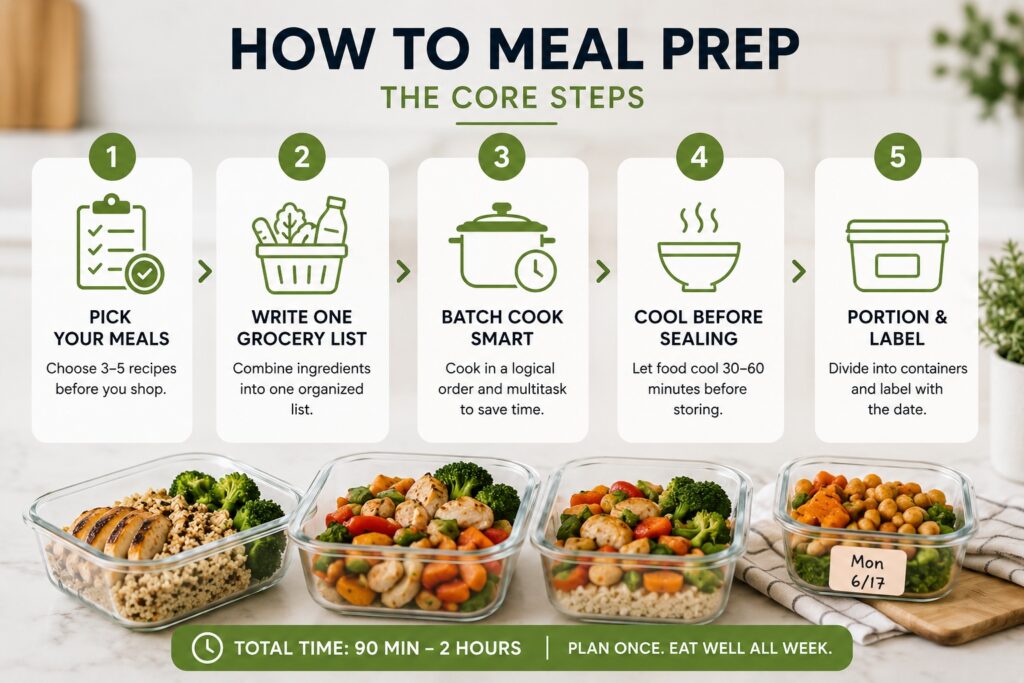
Every solid meal prep guide comes down to the same five steps, done roughly in this order. This meal prep guide treats them as a repeatable cycle rather than a one-time project, since the same five steps apply whether it’s your first Sunday or your fiftieth.
Step 1: Pick Your Meals Before You Shop
Choose three to five meal prep recipes for the week before writing a grocery list, not after. Trying to improvise a week’s worth of meals while standing in a grocery aisle is one of the most common reasons meal prep plans fall apart before they start.
Step 2: Write One Consolidated Grocery List
Combine ingredients across all your chosen recipes into a single list, organized by store section. This cuts down on backtracking through the store and makes it obvious when two recipes share an ingredient, which usually means less waste by the end of the week.
Step 3: Batch Cook in a Logical Order
Start with anything that takes the longest with the least hands-on time, like rice in a rice cooker or a sheet pan of vegetables in the oven, and let those run while you handle quicker tasks like chopping or making a sauce. Most beginners lose time by cooking one thing completely before starting the next, rather than overlapping tasks that don’t need constant attention.
Step 4: Cool Food Before Sealing Containers
Let hot food cool for about 30 to 60 minutes at room temperature, spread out in a shallow container to speed this up, before sealing it and putting it in the fridge. Sealing hot food immediately traps steam, which raises the risk of both sogginess and bacterial growth.
Step 5: Portion and Label
Divide meals into individual containers right after cooking, and label each with the date, not just the contents. A simple piece of tape with the day written on it prevents the guessing game of “is this still good?” by midweek.
Once these five steps feel automatic, an entire prep session for four to five meals typically takes somewhere between 90 minutes and two hours, depending on how many separate dishes you’re making.
A Real Sunday Timeline for This Meal Prep Guide
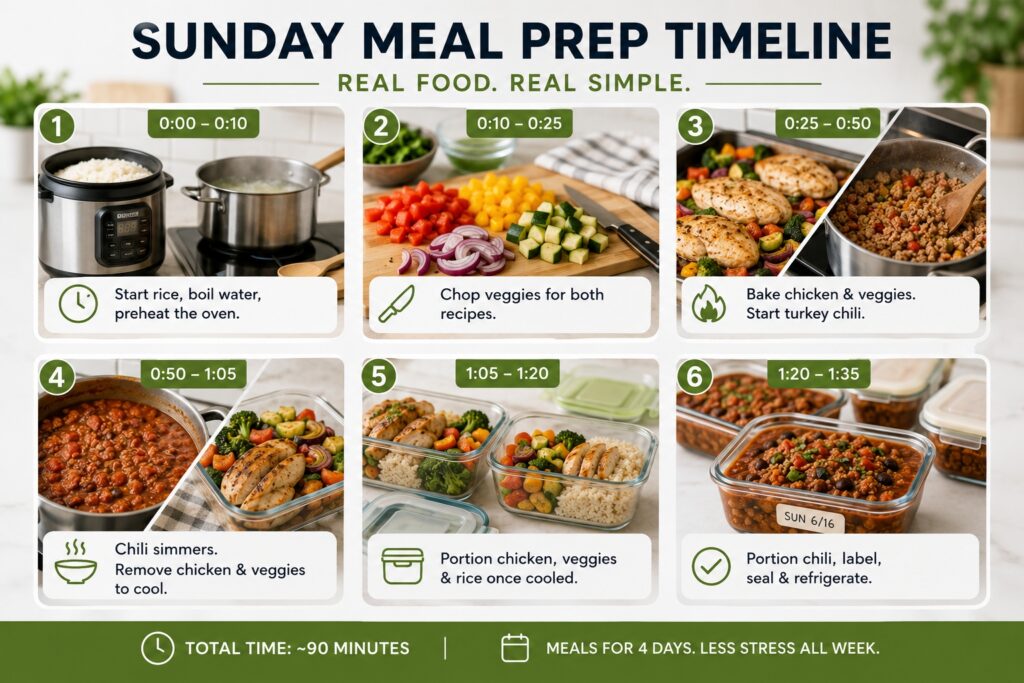
Abstract steps are one thing. Here’s what following this meal prep guide actually looks like in practice, using the baked chicken and turkey chili recipes below as an example.
- 0:00 to 0:10: Preheat the oven, start rice in a rice cooker, and set a pot of water to boil for any grains the turkey chili needs.
- 0:10 to 0:25: Chop vegetables for both the sheet pan and the chili while the oven preheats and rice cooks in the background.
- 0:25 to 0:50: Chicken and vegetables go into the oven. Turkey chili starts browning on the stovetop, stirred occasionally while the oven does the rest of the work.
- 0:50 to 1:05: Chili simmers. Chicken and vegetables come out of the oven and start cooling in shallow containers, uncovered, per the cooling guidance above.
- 1:05 to 1:20: Portion the chicken, vegetables, and rice into containers once cooled to room temperature. Chili continues simmering.
- 1:20 to 1:35: Portion the chili into containers once it’s cooled enough to touch, then seal, label with the date, and refrigerate everything.
That’s roughly 90 minutes for two full meal prep recipes covering four days, which lines up with the time estimate given earlier in this meal prep guide. Actual timing will vary with your stove, oven, and how many separate dishes you’re juggling.
Who This Meal Prep Guide Is For
This meal prep guide is written for someone starting from zero, not someone who’s already comfortable batch cooking. If you’ve never planned a full week of meals, cooked more than one dish at a time, or thought seriously about food storage, the steps in this meal prep guide are meant to be followed roughly in order the first few times.
If you’ve prepared meals before and are looking for something more specific, like a tighter budget, a single serving, or a particular diet pattern, the situational section below points to more targeted resources rather than repeating everything covered generally in this meal prep guide.
Tools and Containers for Meal Prep
A meal prep guide doesn’t need to double as a shopping list for gadgets, but a few specific tools genuinely change how smooth the process feels.
- Glass containers with airtight lids. They don’t absorb odors or stains the way some plastics do, and they show early spoilage more clearly.
- A set of containers in at least two sizes. One larger size for full meals, one smaller for sauces or snacks, covers most of what a typical meal prepping guide calls for.
- A food thermometer. Confirming chicken hits 165°F, or that reheated leftovers reach the same mark, removes guesswork that “it looks done” can’t answer.
- A sheet pan and a large pot. Between these two, most of the recipes in this guide, and in most meal prep recipes generally, get covered without needing specialty equipment.
- Painter’s tape or masking tape and a marker, for labeling containers with the date rather than relying on memory by Thursday.
None of this requires a large upfront investment. Four to six containers, one sheet pan, and a food thermometer cover a beginner’s first several weeks of following any meal prep guide.
How to Reheat Meal Prep Without Ruining It
Reheating gets less attention in most meal prep guide content than cooking does, but it’s often the step that determines whether a dish tastes like it did on day one.
- Rice and grains. Add a splash of water before microwaving, covered, to prevent drying out. Reheat until steaming hot throughout, not just warm in the center.
- Roasted vegetables. A quick reheat in a hot pan or air fryer keeps texture closer to original than a microwave, which tends to make them soft.
- Proteins like chicken or salmon. Reheat gently, covered, with a splash of broth or water, to avoid drying out delicate proteins like fish especially.
- Soups and chili. These generally reheat the most forgivingly of anything in a typical meal prep recipes rotation, since added liquid prevents drying out.
- Salads with raw vegetables. Don’t reheat at all. These are meant to be eaten cold, and the reheating step is really just adding any dressing that was stored separately.
Meal Prep Recipes to Start With
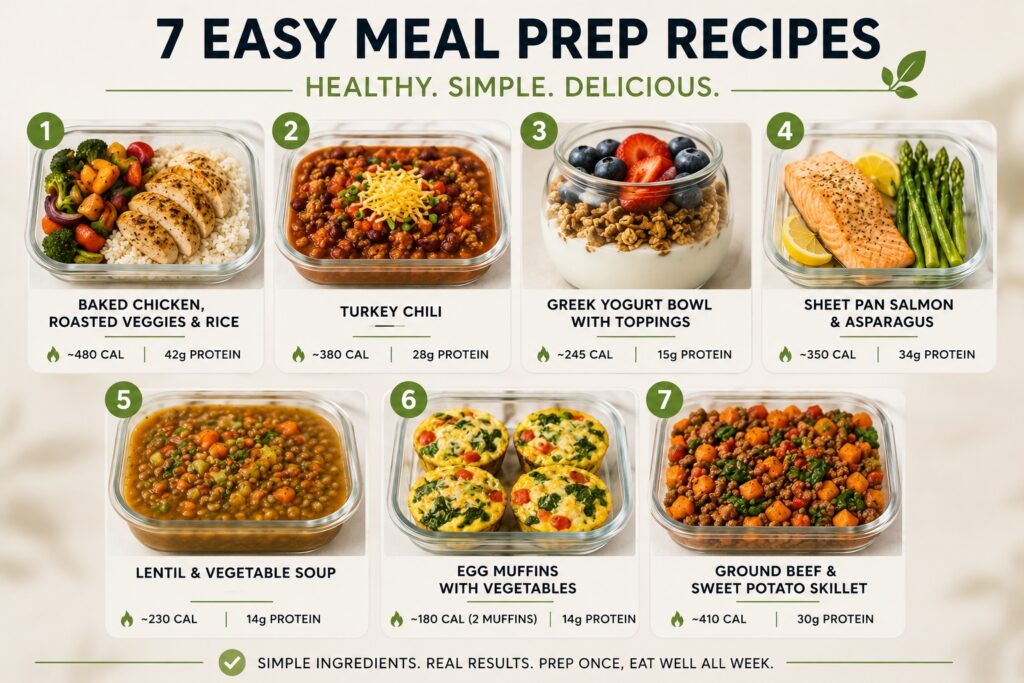
These easy healthy meal prep recipes for Meal Prep Guide are meant as a starting point, not a rigid list. Each one uses common ingredients and holds up well across the 3-to-4-day fridge window discussed above.
1. Baked Chicken, Roasted Vegetables, and Rice
Season chicken breasts and roast at 400°F for about 25 minutes while a sheet pan of vegetables roasts alongside, and rice cooks separately. This is one of the most common high protein meal prep recipes for a reason: it reheats evenly and doesn’t separate.
- Approximate macros per serving: ~480 cal, ~42g protein
2. Turkey Chili
Browning ground turkey with beans, tomatoes, and chili spices makes a big-batch dish that actually improves after a day in the fridge, since the flavors have more time to combine. It also freezes well if you want to stretch it past the 4-day window.
- Approximate macros per serving: ~380 cal, ~28g protein
3. Greek Yogurt Bowls with Toppings
Portion plain Greek yogurt into jars and store toppings, like granola and berries, separately to add right before eating. Among easy healthy meal prep recipes, this is one of the few that needs zero cooking at all.
- Approximate macros per serving: ~245 cal, ~15g protein
4. Sheet Pan Salmon and Asparagus
Salmon fillets and asparagus roast together on one pan in about 12 to 15 minutes, making this one of the faster meal prep recipes to prepare, even though salmon is best eaten within 2 to 3 days rather than stretched to day four.
- Approximate macros per serving: ~350 cal, ~34g protein
5. Lentil and Vegetable Soup
A pot of lentil soup with carrots, celery, and onion holds up for about 4 to 5 days in the fridge, longer than most protein-forward dishes, which makes it a useful anchor for the back half of the week.
- Approximate macros per serving: ~230 cal, ~14g protein
6. Egg Muffins with Vegetables
Whisked eggs baked in a muffin tin with chopped vegetables and a little cheese make one of the more flexible meal prep recipes high protein options for breakfast, and they freeze well if you don’t get through a full batch in four days.
- Approximate macros per serving (2 muffins): ~180 cal, ~14g protein
7. Ground Beef and Sweet Potato Skillet
Browned ground beef, diced sweet potato, and a handful of spinach cooked together in one pan make a simple, one-skillet option among these meal prep recipes high protein choices, with minimal cleanup.
- Approximate macros per serving: ~410 cal, ~30g protein
Macros above are cross-checked across multiple nutrition sources, including USDA FoodData Central and MyNetDiary, and will vary somewhat with exact brands and portion sizes.
How Many Calories Should a Meal Prep Recipe Have?
This question comes up constantly, and the honest answer is that it depends entirely on your own needs, activity level, and goals, which a general meal prep guide can’t calculate for you individually.
That said, most of the meal prep recipes in this guide land in a 200 to 500 calorie range per serving, which fits reasonably within a typical meal for many adults without requiring precise tracking. If you’re specifically looking for meal prep recipes high protein enough to support muscle maintenance or a more active lifestyle, aim for recipes delivering at least 25 to 30 grams of protein per serving, which several of the seven recipes above clear comfortably. The egg muffins, ground beef skillet, and baked chicken bowl are the three easiest meal prep recipes high protein picks from this list if that’s your main filter.
For anyone tracking more closely, a registered dietitian can help translate general guidance like this into numbers specific to your body and goals, which is a more reliable approach than applying a one-size-fits-all calorie target from any single meal prep guide, including this one.
Common Meal Prep Mistakes and Myths
A few patterns and misconceptions come up again and again with anyone new to following a meal prep guide. Most of what derails a first attempt at this meal prep guide traces back to one of these six issues.
- Believing meal prep has to mean five identical meals. Rotating between two or three meal prep recipes prevents the boredom that ends most people’s meal prep habit within a few weeks.
- Skipping the cooling step. Sealing hot containers immediately traps moisture and raises food safety risk, even though it feels like it’s saving time.
- Treating all foods as equally durable. Rice, seafood, and dairy-based sauces spoil faster than roasted vegetables or beans, so building a week around this difference avoids a lot of disappointing Thursday lunches.
- Assuming “high protein meal prep recipes” always means more effort. Some of the simplest options, like Greek yogurt bowls or a big batch of hard-boiled eggs, deliver meaningful protein without much active cooking time.
- Prepping an entire week in one session without any backup plan. If one dish doesn’t turn out well, or you’re simply tired of it by Wednesday, having one flexible, no-cook option on hand prevents a full derailment.
- The myth that meal prep must be bland to be healthy. Spices, sauces, and marinades survive reheating fine, and flavor is often what determines whether a meal prep plan actually gets finished or abandoned by day three.
A 7-Day Meal Prep Guide for Beginners
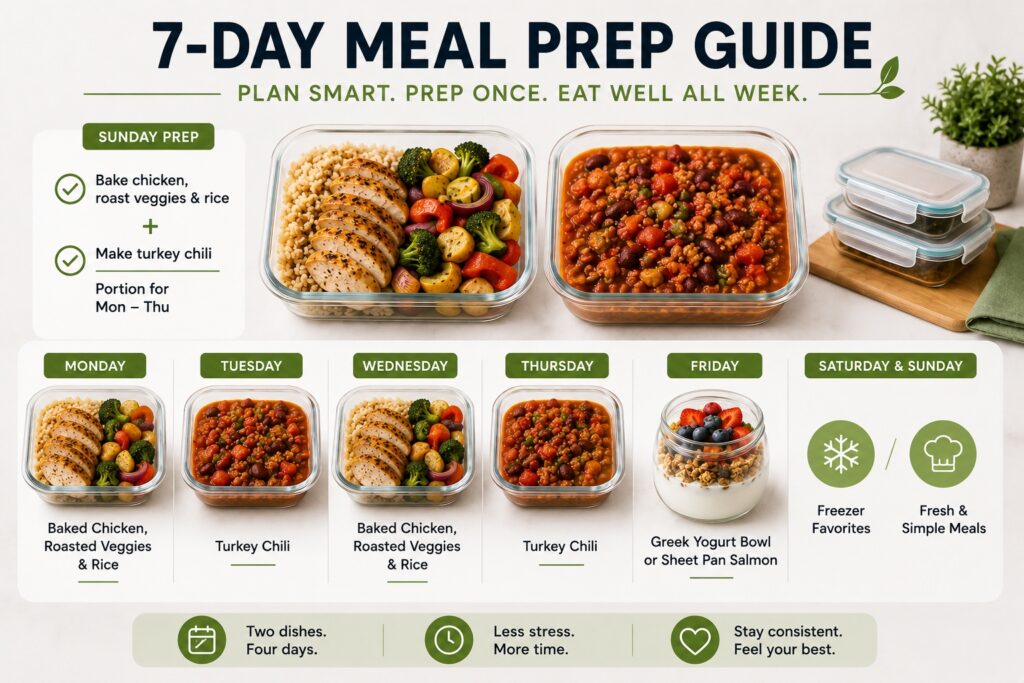
Rather than prepping seven identical days, here’s a practical framework that mixes two prep sessions and a bit of freezer backup.
Sunday prep session: Cook the baked chicken, roasted vegetables, and rice recipe above, and a batch of turkey chili. Portion both into containers for Monday through Thursday.
- Monday: Baked chicken, roasted vegetables, and rice.
- Tuesday: Turkey chili.
- Wednesday: Baked chicken, roasted vegetables, and rice (second portion).
- Thursday: Turkey chili (second portion).
- Friday: Greek yogurt bowl or sheet pan salmon, prepared fresh or from a quick 15-minute cook, since anything from Sunday’s batch is now past the 4-day safety window.
- Saturday and Sunday: Leftover flexibility, freezer portions from an earlier week, or a fresh, simple meal, since most people don’t need every single day pre-planned to benefit from a meal prep routine.
This structure, two dishes covering four days, with fresh or freezer options filling the rest, tends to be more sustainable for beginners than trying to plan and cook seven distinct meals in a single Sunday session.
Meal Prep for Different Situations
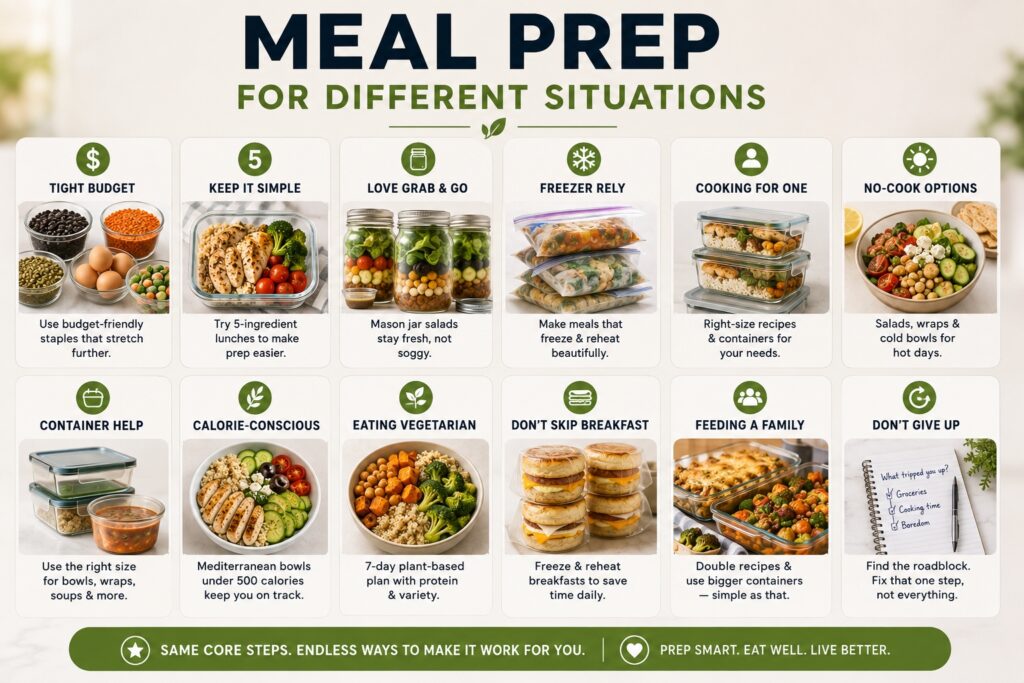
Not every meal prep guide fits every household, so here’s how the core steps above adjust for specific situations.
- Tight budget: Beans, lentils, eggs, and frozen vegetables stretch further than fresh meat and produce, and a full breakdown of building high-protein meal prep recipes on a limited weekly grocery budget covers this in more depth.
- Want a simpler starting point: If five ingredients feels more realistic than a full recipe box, a beginner-focused set of 5-ingredient lunch ideas simplifies both the grocery list and the cooking steps without sacrificing protein.
- Like visual, grab-and-go meals: A mason jar approach to salads keeps dressing separate from greens, which solves one of the most common meal prep complaints about soggy vegetables.
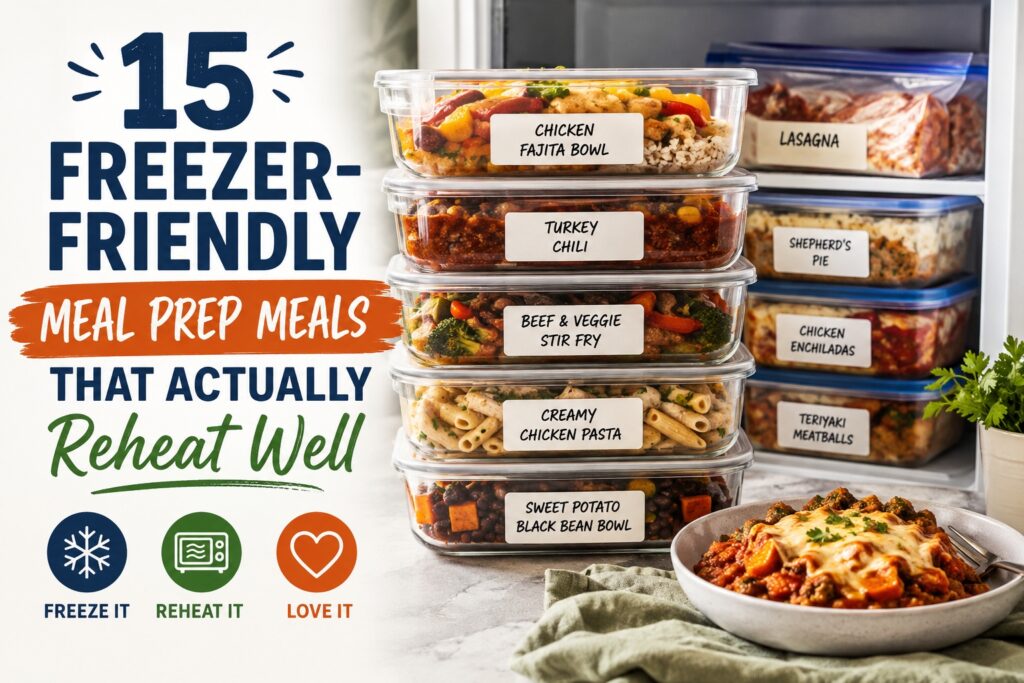
- Rely heavily on the freezer: A guide focused specifically on meals that actually reheat well after freezing addresses which dishes hold their texture and which ones don’t.
- Cooking for just yourself: Scaling recipes down and choosing appropriately sized containers matters more than most general advice accounts for, which a dedicated single-serving weekly plan addresses directly.
- Kitchen gets too hot for the oven: A set of no-cook ideas built specifically for warm weather covers salads, wraps, and cold bowls that skip the stove entirely.
- Container confusion is slowing you down: A sizing guide matched to specific meal types, bowls, wraps, soups, takes the guesswork out of which container to buy or reuse.
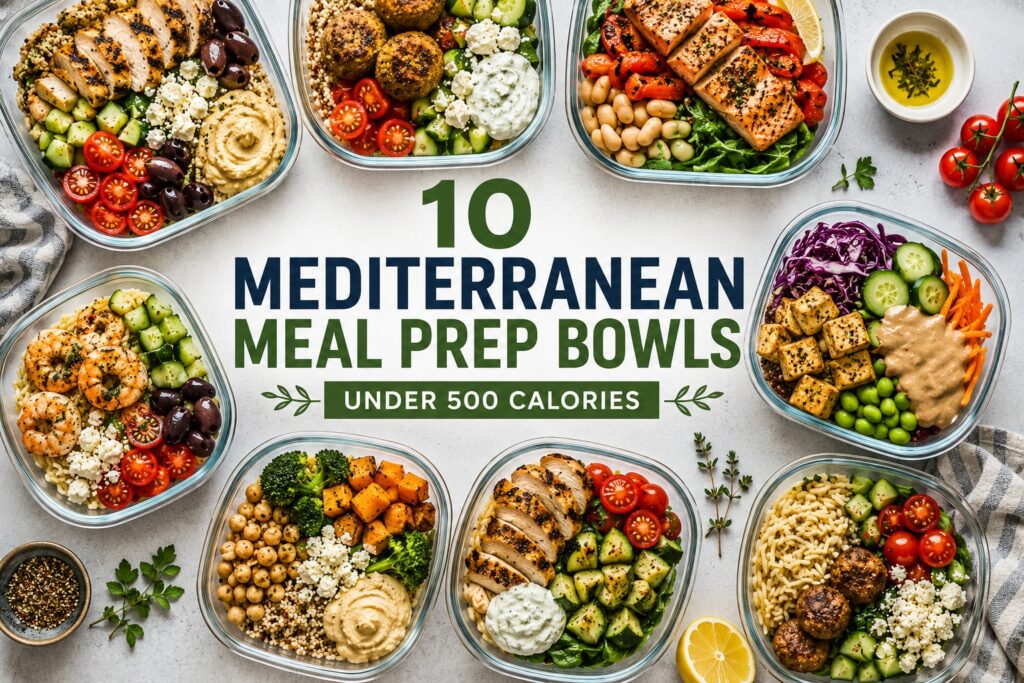
- Want a calorie-conscious framework: A set of Mediterranean-style bowls kept under 500 calories each offers a more structured starting point than freeform recipe swapping.
- Eating vegetarian: A full 7-day starter plan built around plant-based proteins covers the same core steps in this guide without requiring any meat substitutions or separate research.
- Breakfast is the meal most likely to get skipped: A freezer-and-reheat guide for breakfast sandwiches extends the same batch-cooking logic used for lunch and dinner to the start of the day.
- Feeding a full household: Doubling any of the meal prep recipes above generally works without changing cook times much, though oven-based recipes may need a few extra minutes when pans are fuller. Scaling a meal prep guide up for a family mostly comes down to bigger containers and a longer grocery list, not a fundamentally different process.
- Tried a meal prepping guide before and given up: It’s worth identifying which specific step caused the drop-off, whether that was the grocery list, the cooking time, or boredom with the meals themselves, since the fix usually targets that one step rather than requiring a completely different approach.
Key Takeaways
- A meal prep guide doesn’t require identical meals all week. Component prep and ingredient prep count just as much as fully cooked dishes.
- USDA and FDA guidance points to a 3-to-4-day fridge window for most cooked meal prep recipes, with rice and seafood on the shorter end of that range.
- Cooling food for 30 to 60 minutes before sealing containers reduces both sogginess and food safety risk.
- Rotating between two or three recipes at a time, rather than one recipe for five days straight, is the biggest factor in whether a meal prep guide actually becomes a lasting habit.
- A 7-day meal prep guide doesn’t need seven distinct dishes. Two solid recipes covering four days, plus flexible or freezer-based options for the rest, tends to hold up better in practice.
Frequently Asked Questions
- How long does meal prep last in the fridge?
Most cooked meal prep recipes are safe for 3 to 4 days in the fridge at or below 40°F, according to USDA and FDA guidance, though rice and seafood are best eaten closer to the 3-day mark for both safety and texture. This is one of the most frequently asked questions about any meal prep guide, and it’s worth checking against current USDA guidance periodically since recommendations can be refined over time.
- How many hours should Meal Prep Guide take on a Sunday?
A typical prep session covering four to five meals takes roughly 90 minutes to two hours once the core steps in this meal prep guide become familiar, though the first few sessions often take longer while you’re still learning your own kitchen’s timing.
- What are the easiest meal prep recipes for a beginner?
Recipes with minimal steps and forgiving reheating, like baked chicken with roasted vegetables, turkey chili, or Greek yogurt bowls, tend to be the easiest starting point, since none of them require precise timing to turn out well.
- Do high protein meal prep recipes take more time to cook?
Not necessarily. Some high protein meal prep recipes, like Greek yogurt bowls or hard-boiled eggs, need little to no active cooking time, while others, like baked chicken, mainly need hands-off oven time rather than constant attention.
- Can Meal Prep Guide help with weight loss?
Meal prep may support weight management for some people by making portioned, planned meals more convenient than takeout, but it isn’t a guaranteed weight-loss method on its own, since the nutritional content of what’s prepped still matters most.
- Is it safe to Meal Prep Guide for a full 7 days at once?
Most food safety guidance points to a 3-to-4-day fridge window, so a full 7-day meal prep guide generally works better as two shorter prep sessions, or one session plus freezer storage, rather than one batch meant to last the entire week unchanged.
- What equipment do I actually need to follow a meal prep guide?
A basic setup, a handful of glass containers, one sheet pan, a large pot, and a food thermometer, covers most of what any meal prepping guide asks for, without needing specialty gadgets.
- How do I reheat meal prep recipes without drying them out?
Add a splash of water or broth before reheating rice, grains, or proteins, and cover the container while microwaving, since covered, gently reheated food generally holds moisture better than an uncovered, high-power reheat.
Conclusion
A working meal prep guide is less about a single rigid formula and more about a handful of repeatable habits: picking meals before shopping, batching efficiently, cooling food properly, and rotating between a few recipes instead of one. None of that requires advanced cooking skill, just a consistent Sunday routine that fits your actual week.
Whichever version of this meal prep guide you start with, full-meal prep, component prep, or just a stocked fridge, the goal is the same: making weeknight eating easier without turning Sunday into a second job.
If you’re ready to go deeper into any one piece of this, The Daily Crave covers meal prep from a lot of angles, including budget-friendly plans, single-serving guides, and specific meal prep recipes for different situations, so there’s more to explore once these core steps feel familiar.