Table of Contents
If you’ve ever packed a lunch that barely fit under the lid, or opened a dinner container with so much empty space the food slid around in your bag, the problem usually isn’t your cooking. It’s the container. Choosing the best meal prep containers for each meal type is one of the most overlooked parts of a meal prep routine, and it’s also one of the easiest to fix once you know the actual sizes to buy.
This guide covers the right size for breakfast, lunch, dinner, and snacks, compares glass and plastic, walks through how many containers you actually need, and flags the mistakes that make people abandon meal prep containers within a few weeks. For the full weekly system, pair this with our complete meal prep guide.
1. Why Container Size Actually Matters
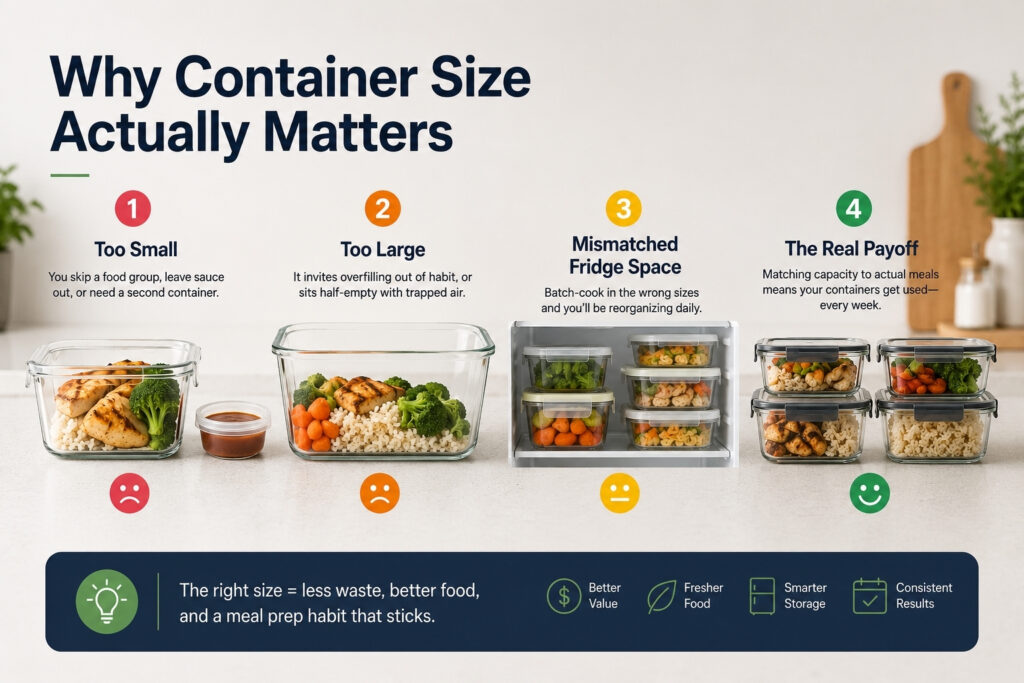
Most people shopping for the best meal prep containers start with the design , color, stackability, how it looks on a shelf , and skip the sizing question entirely. Then they wonder why their meal prep habit falls apart in week two.
1. Too Small
With the best meal prep containers, going too small means you skip a food group, leave sauce out, or need a second container just to fit everything.
2. Too Large
Going oversized on the best meal prep containers invites overfilling out of habit, or leaves enough trapped air that food goes soft or oxidizes faster.
3. Mismatched Fridge Space
Batch-cook a week of dinners in the wrong sizes and you’ll be reorganizing your fridge shelf daily just to make room.
4. The Real Payoff
Matching capacity to the actual volume of a meal , not a rough guess , is what makes the best food storage containers worth the money, and it’s the biggest factor in whether a set gets used every week or ends up pushed to the back of a cabinet.
2. Best Meal Prep Containers by Meal Type
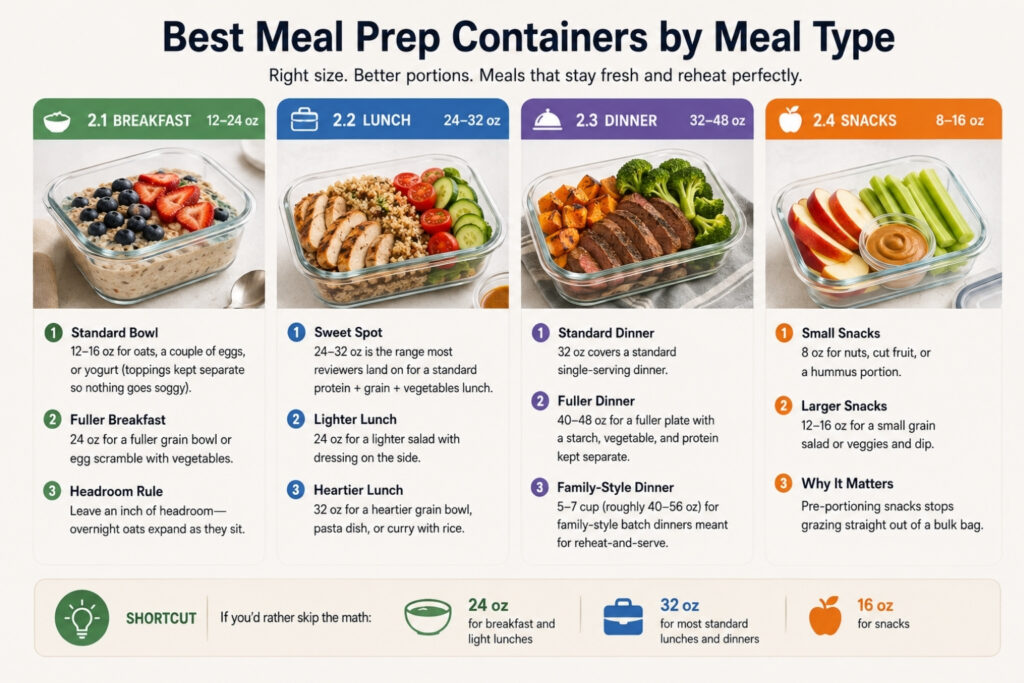
There’s no single best containers meal prep size that works for every dish, because breakfast, lunch, dinner, and snacks each behave differently once food is packed in and refrigerated.
2.1 Breakfast: 12–24 oz
1. Standard Bowl
Among the best meal prep containers for breakfast, 12–16 oz works for oats, a couple of eggs, or yogurt (toppings kept separate so nothing goes soggy).
2. Fuller Breakfast
24 oz for a fuller grain bowl or egg scramble with vegetables.
3. Headroom Rule
Leave an inch of headroom , overnight oats expand as they sit.
2.2 Lunch: 24–32 oz
1. Sweet Spot
24–32 oz is the range most reviewers land on for a standard protein + grain + vegetables lunch, and it’s where you’ll find the best meal prep containers for daily use.
2. Lighter Lunch
24 oz for a lighter salad with dressing on the side.
3. Heartier Lunch
32 oz for a heartier grain bowl, pasta dish, or curry with rice.
2.3 Dinner: 32–48 oz
1. Standard Dinner
Among the best meal prep containers for dinner, 32 oz covers a standard single-serving portion.
2. Fuller Dinner
40–48 oz for a fuller plate with a starch, vegetable, and protein kept separate.
3. Family-Style Dinner
5–7 cup (roughly 40–56 oz) for family-style batch dinners meant for reheat-and-serve.
2.4 Snacks: 8–16 oz
1. Small Snacks
8 oz for nuts, cut fruit, or a hummus portion.
2. Larger Snacks
12–16 oz for a small grain salad or veggies and dip.
3. Why It Matters
Among the best meal prep containers, pre-portioning snacks stops grazing straight out of a bulk bag.
4. Shortcut
If you’d rather skip the math when picking the best meal prep containers: 24 oz for breakfast and light lunches, 32 oz for most standard lunches and dinners, 16 oz for snacks.
3. Best Meal Prep Containers by Material
3.1 Glass
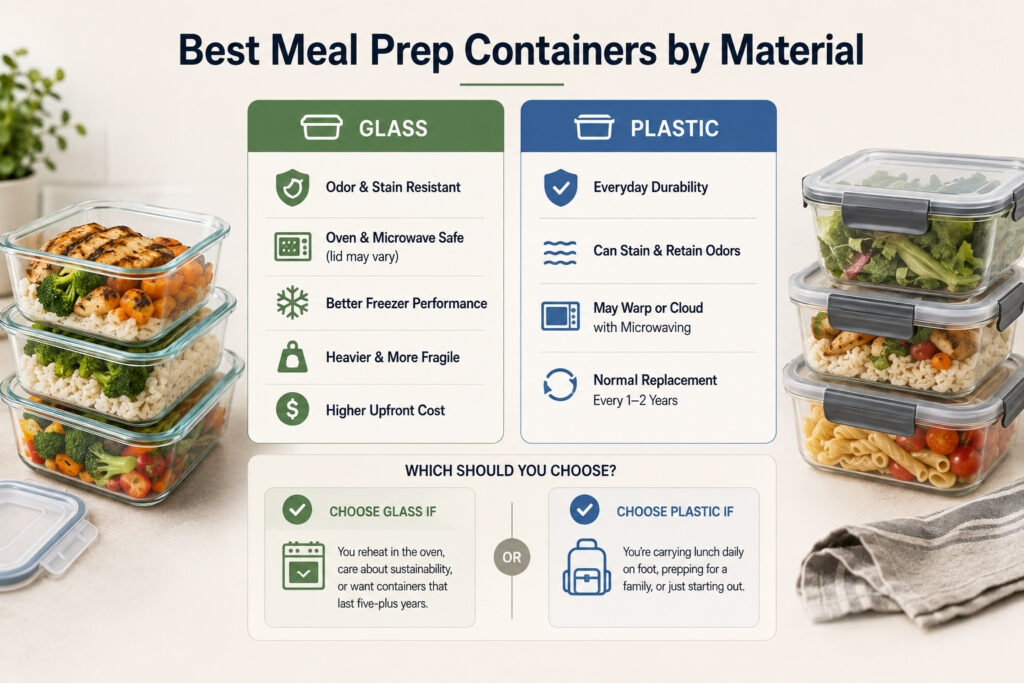
The best glass meal prep containers , sometimes typed into search as best meal prep containers glass , tend to hold up better over years of daily use.
1. Odor and Stain Resistance
Among the best meal prep containers, glass doesn’t absorb odors or stain from tomato-based sauces or turmeric-heavy curries.
2. Oven and Microwave Safe
Fully oven-safe and microwave-safe (check the lid separately , many lids are still plastic).
3. Freezer Performance
Protects food better in the freezer against freezer burn.
4. Weight and Fragility
Heavier to carry and can chip or crack if dropped.
5. Upfront Cost
A full set of the best meal prep containers in glass usually costs more upfront.
3.2 Plastic
Plastic is lighter, cheaper, and more forgiving if dropped.
1. Everyday Durability
Good BPA-free plastic among the best meal prep containers is dishwasher- and freezer-safe and stacks easily.
2. Staining and Odor
Can stain from tomato sauce or turmeric and retain odors over time.
3. Microwave Wear
Can warp or cloud with repeated microwave use.
4. Replacement Cycle
Replacing a set every year or two is normal, not a sign of a bad one.
3.3 Which Should You Choose?
1. Choose Glass If
You reheat in the oven often, care about sustainability, or want the best meal prep containers to last five-plus years.
2. Choose Plastic If
You’re carrying lunch daily on foot, prepping for a family, or just starting out among the best meal prep containers on the market.
4. How Many Containers You Actually Need
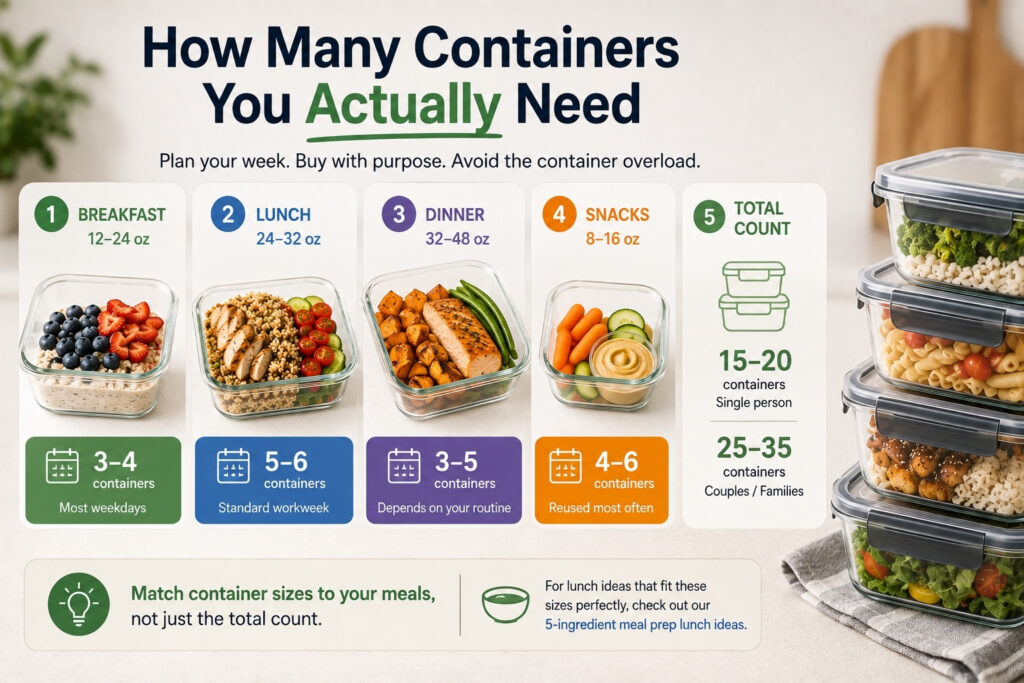
A common mistake is buying one giant set and assuming quantity alone solves the sizing problem with the best meal prep containers. A more useful approach is to work backward from your actual week.
1. Breakfast Range
3–4 of the best meal prep containers in the 12–24 oz breakfast range, if you eat breakfast at home or on the go most weekdays.
2. Lunch Range
5–6 containers in the 24–32 oz lunch range, enough for a standard workweek without needing to wash mid-week.
3. Dinner Range
3–5 containers in the 32–48 oz dinner range, fewer if you cook some dinners fresh instead of prepping every night.
4. Snack Range
4–6 containers in the 8–16 oz snack range, since these tend to get reused most often within a single week.
5. Total Count
That puts most single-person households at roughly 15–20 of the best meal prep containers across sizes. Couples and families generally need closer to 25–35. For lunches already sized to fit these ranges exactly, see our 5-ingredient meal prep lunch ideas.
5. Common Mistakes With Meal Prep Containers
1. Buying One Size for Everything
A single 32 oz container might be marketed as one of the best meal prep containers for all-purpose use, but using it for breakfast oats and afternoon snacks wastes fridge space that smaller containers would use far more efficiently.
2. Ignoring the Lid Separately From the Container
Even the best containers meal prep sets include can fail if the lid seal is weak or the hinge cracks after a few months. A container that leaks in a bag gets abandoned fast, no matter how well-sized it is.
3. Skipping Compartments When a Meal Needs Them
Some dinners , anything with a sauce that shouldn’t touch rice, or a dressing that shouldn’t wilt greens overnight , need a 2- or 3-compartment container. Forcing them into a single-compartment container leads to soggy leftovers by the next day.
4. Not Accounting for Freezer Expansion
Liquids and soups expand as they freeze. Filling a container to the brim before freezing it is one of the most common reasons lids crack or pop off, especially with rigid plastic that has less give than glass.
5. Overbuying Instead of Right-Sizing
A stack of oversized containers that don’t match your actual portions gets used less than a smaller set of the best meal prep containers sized correctly from the start. For portions already mapped to standard container sizes, see our high-protein meal prep on a budget guide.
6. Mixing Metal Utensils With Coated Plastic
Scraping a metal spoon or fork against certain plastics scratches the surface, which traps bacteria and stains over time even with regular washing.
6. Buying Checklist
Run through this before adding another set to your cart.
1. Match the Size to the Meal
Check the oz ranges above instead of the marketing photo when picking the best meal prep containers.
2. Check the Lid Rating Separately
Not every lid on a good set is actually microwave-safe.
3. Decide Glass vs. Plastic by How You’ll Carry Them
Weight matters more if you’re walking or biking to work.
4. Buy in Mixed Sizes
An all-32-oz set of the best meal prep containers leaves breakfast and snacks poorly sized.
5. Confirm Stackability
Non-stacking containers eat up more fridge space than their capacity suggests.
6. Look for a Genuine Leak-Proof Seal
A seal that only “mostly” holds will show it the first time you tilt a bag.
7. Check Dishwasher Placement Guidance
Some plastics are top-rack only , running them on the bottom rack near the heating element accelerates warping.
7. Budget vs. Long-Term Cost
1. Price Point Isn’t the First Differentiator
Cheap and mid-range plastic among the best meal prep containers can both survive a year of regular use; the gap shows up in lid seal quality, stain resistance, and whether the set still stacks evenly after months of dishwasher cycles.
2. Lid Design Matters More Than Price
A better lid design outlasts a bargain set by a wide margin, even though both look identical on day one.
3. Glass Cost-Per-Use
Glass often works out cheaper per use over a year than replacing a plastic set annually, since it doesn’t warp in the dishwasher.
4. Sustainability
Sustainability math favors glass long-term, provided you’re fine with the added weight.
5. Diet-Based Sizing
Higher-protein meals with less starchy volume sometimes fit a slightly smaller container than a carb-heavy plate of the same calories. Our high-protein meal prep on a budget guide and 15 healthy freezer meals roundup list exact sizes per recipe.
8. Sizing by Diet Goal
Container size isn’t purely about the meal type , what you’re eating shifts it slightly too.
1. Weight Loss / Calorie Deficit
24 oz among the best meal prep containers tends to work as a built-in portion guide for main meals, since the container itself limits overfilling without needing to weigh food.
2. High-Protein, Lower-Carb Plates
Often fit a size smaller than a carb-heavy plate of the same calories, since protein and vegetables take up less volume than rice or pasta.
3. Muscle Gain / Higher-Calorie Plans
Usually need the 40–48 oz dinner range or a second container for extra carbs, since a single 32 oz container runs out of room fast.
4. Intermittent Fasting, One Big Meal
A 40–48 oz container or two stacked 24 oz containers cover a single larger eating window better than a standard single lunch size. Our high-protein meal prep on a budget guide lists the exact container size used per recipe if you want to match these directly.
9. Building a Routine Around Your Containers
Once you’ve settled on sizes and material, the containers only pay off if they fit into a routine you’ll actually repeat.
1. Wash and Dry Immediately After Use
Any of the best meal prep containers left in a bag overnight develops odors faster than any material difference accounts for.
2. Label by Day, Not Just by Meal
Saves you from opening every container to find the right one, especially past ten or twelve pieces.
3. Rotate Instead of Stockpiling One Favorite
Reaching for the same container every time wears it out early while the rest sit unused.
4. Reassess Your Sizes Every Few Months
Portion needs change with a new recipe rotation , a five-minute check can save you from buying a whole new set out of frustration later. For a done-for-you version of this routine, our no-cook meal prep ideas for hot weather, mason jar salad meal prep combos, and meal prep for one person weekly plan all build their portions around the exact sizes covered in this guide.
10. Shopping by Container Type
Not every container on the shelf is built the same way, and the format matters as much as the size.
1. Single-Compartment Containers
Among the best meal prep containers, the simplest option , best for grain bowls, stir-fries, or any meal meant to mix together anyway.
2. 2-Compartment Containers
Good for a protein-and-side split, like rice separated from a saucy curry.
3. 3-Compartment Containers
Best for a full plate , protein, starch, and vegetable each kept apart until you’re ready to eat.
4. Mason Jars and Wide-Mouth Jars
Work well for layered salads and overnight oats, though they’re less practical for hot dinners.
5. Stackable Bento-Style Sets
Save the most fridge space if you’re prepping for more than one person, since uniform shapes nest cleanly.
6. Silicone Collapsible Containers
Useful for travel or small kitchens, though they don’t insulate as well and can retain odors longer than rigid plastic or glass.
11. Key Takeaways
1. Size by Meal
Breakfast fits 12–24 oz, lunch 24–32 oz, dinner 32–48 oz, and snacks 8–16 oz , that range covers nearly every meal among the best meal prep containers.
2. Glass vs. Plastic
Glass containers last longer and resist stains and odors, but cost more and weigh more than plastic.
3. Total Container Count
A well-sized set of roughly 15–20 of the best meal prep containers covers a full week for one person without overbuying.
4. Match Portion to Container
Matching portion size to container size, not the other way around, is what actually makes a set get used week after week.
5. Compartments and Lids
Compartments matter for meals with sauces or dressings that shouldn’t mix before reheating, and lids deserve as much attention as the container itself.
6. Diet Goals Shift Sizing
A high-protein plate can run a size smaller than a carb-heavy one at the same calorie count.
7. Mixed Sizes Beat Uniform Packs
Buying mixed sizes beats buying one uniform pack, even if the uniform pack looks like better value on price alone.
12. FAQ
1. What size container is best for meal prep?
For most single-serving lunches and dinners, a 24–32 oz container is the best all-purpose size among the best meal prep containers. Use 12–16 oz containers for breakfast and snacks, and 32–48 oz for larger dinners or family-style portions.
2. Is it better to use glass or plastic meal prep containers?
Neither is universally better. Glass is more durable, oven-safe, and resistant to staining, while plastic is lighter, cheaper, and more practical for carrying daily. Many households end up using a mix of both depending on the meal.
3. How many meal prep containers do I need for a week?
Most single-person households do well with 15–20 of the best meal prep containers total across breakfast, lunch, dinner, and snack sizes. Couples or families typically need closer to 25–35, especially if portions differ between household members.
4. Can I use the same container size for every meal?
You can, but it usually leads to wasted space or overly cramped meals, since breakfast and snack portions are typically much smaller than lunch and dinner. Sizing by meal type gives more consistent results than using one size across the board.
5. Do meal prep containers need to be microwave-safe?
If you plan to reheat meals directly in the container, yes , check the label for microwave safety specifically, since not all plastics and not all lids are rated for it. Glass is microwave-safe more consistently, though lids should still be checked individually.
6. Are compartment containers better than single-compartment ones?
It depends on the meal. Compartments are worth it when a sauce, dressing, or wet ingredient needs to stay separate until reheating. For meals meant to mix anyway, like a grain bowl or stir-fry, a single-compartment container in the right size works just as well and is usually easier to clean.
7. Can meal prep containers go in the freezer?
Most plastic and glass containers marketed for meal prep are freezer-safe, but check the label rather than assuming. Leave headroom for expansion, and avoid glass with narrow necks for liquids, since uneven expansion is more likely to crack it.
8. Do I need different containers for meal prep vs. regular leftovers?
Not strictly, but meal-prep-specific sets are usually sized in the 24–32 oz single-portion range, while general leftover containers skew larger and less uniform in shape , which matters less for daily lunches and more for stacking a full week in the fridge at once.
9. How long do meal prep containers actually last?
A well-made plastic set typically holds up for one to two years of regular use before staining, warping, or lid fatigue sets in. Glass, if you don’t drop it, can realistically last five or more years without a noticeable drop in performance.
Conclusion
The best meal prep containers aren’t the ones with the most reviews online , they’re the ones sized to match what you actually eat. Start with the meal-type breakdown above, pick glass or plastic based on how you’ll use them day to day, and build your collection around your real weekly rotation instead of a single oversized multi-pack. For more ready-to-use portion ideas built around these exact sizes, check out our website The Daily Crave and our 15 healthy freezer meals roundup as well.