
Table of Contents
Introduction
Gut health has become one of those phrases that shows up everywhere, from supplement ads to grocery store labels, and it’s easy to tune it out as another wellness buzzword. But your gut does far more than digest food. It houses trillions of bacteria that interact with digestion, immune function, and even mood, which is exactly why gut health deserves a closer, calmer look than most headlines give it.
This guide is meant to be the one place you can start. At The Daily Crave (thedailycrave.online), we cover gut health from a lot of angles across the site, and this article pulls the foundational pieces together in one spot: what gut health actually means, the signs your gut might be out of balance, which foods are easier to digest, and a simple 7-day plan to put it all into practice.
Think of this as the map, not the whole territory. Once you understand the basics of gut health here, you can go deeper into any single piece, whether that’s fiber, probiotics, or the gut-brain connection, in more detail on our gut health category page.
What Is Gut Health, Exactly?
Gut health generally refers to the balance and function of the digestive system, especially the trillions of bacteria, fungi, and other microbes living in your intestines, collectively known as the gut microbiome. A balanced gut microbiome is associated with smoother digestion, though research is still evolving on exactly how much any single factor contributes.
When people talk about improving gut health, they’re usually talking about supporting that microbial balance through diet, lifestyle, and sometimes targeted supplements. It’s less about any one “superfood” and more about a collection of small, repeatable habits.
It’s worth saying clearly: gut health isn’t a single number you can measure at home, and no article, including this one, can promise a specific outcome. What this guide can do is lay out what current research and clinical guidance generally suggest, so you can make informed choices with your doctor or dietitian.
Signs of an Unhealthy Gut: Full Symptom Checklist
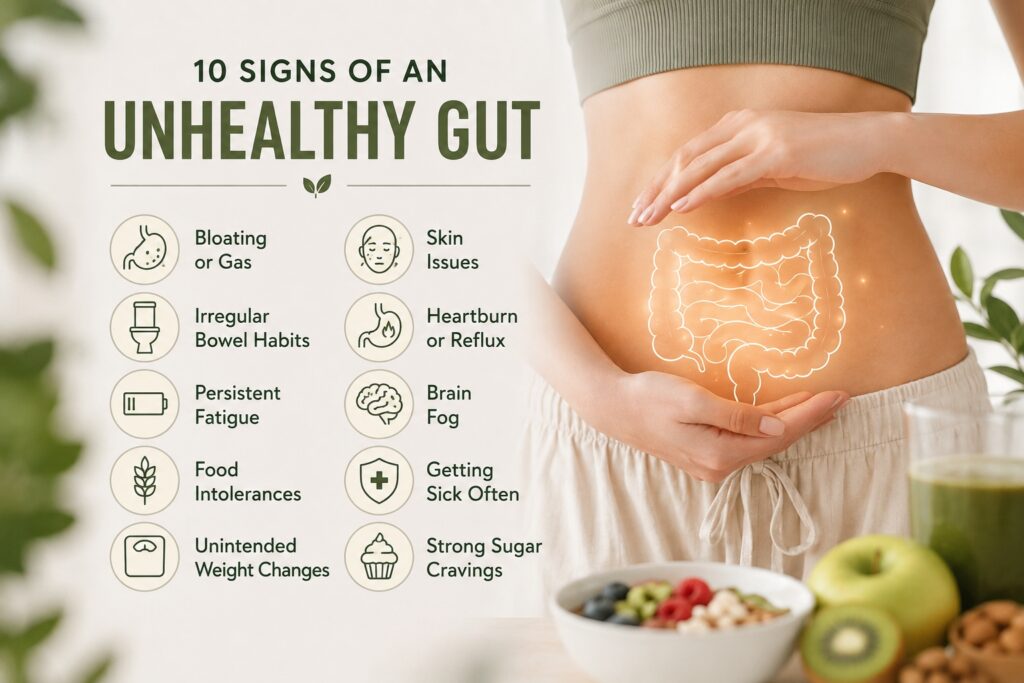
Before diving into fixes, it helps to know what an out-of-balance gut can actually look like. The signs of an unhealthy gut aren’t always dramatic, and many overlap with other conditions, which is part of why persistent symptoms deserve a medical opinion rather than guesswork.
Here are 10 signs of an unhealthy gut that come up most often in both research and everyday conversations about digestion:
- Frequent bloating or gas after meals, especially when it happens regularly rather than occasionally.
- Irregular bowel habits, including ongoing constipation, diarrhea, or a pattern that swings between the two.
- Persistent fatigue that doesn’t clearly connect to sleep or stress.
- Food intolerances that seem to appear or worsen over time.
- Unintentional weight changes without a clear shift in diet or activity.
- Skin issues like eczema or acne that flare alongside digestive symptoms.
- Frequent heartburn or acid reflux after typical meals.
- Difficulty concentrating, sometimes described as brain fog.
- Getting sick often, since a large portion of immune activity is tied to the gut.
- Strong, frequent sugar cravings that feel harder to manage than usual.
None of these signs of an unhealthy gut are diagnostic on their own. Plenty of people experience one or two occasionally without anything being wrong. But when several of these show up together and stick around, it’s a reasonable prompt to bring it up with a doctor, since gut-related symptoms can also overlap with other conditions that need their own evaluation.
A few of these signs of an unhealthy gut deserve a bit more context, since they’re often misread as unrelated issues:
Bloating and gas
The most commonly reported, but timing matters. Bloating that shows up consistently after specific foods is different from occasional bloating after a large meal, and the first pattern is more worth tracking.
Skin flare-ups
One of the least intuitive signs of an unhealthy gut, since most people don’t connect a breakout to digestion. Researchers sometimes refer to a gut-skin axis, though the exact mechanisms are still being studied.
Sugar cravings
Can be partly influenced by which bacteria are more dominant in your gut, since certain strains respond to and even seem to encourage the foods that feed them. This doesn’t mean cravings are entirely out of your control, but it’s a useful reframe if willpower alone hasn’t worked.
Gut Health Myths Worth Retiring
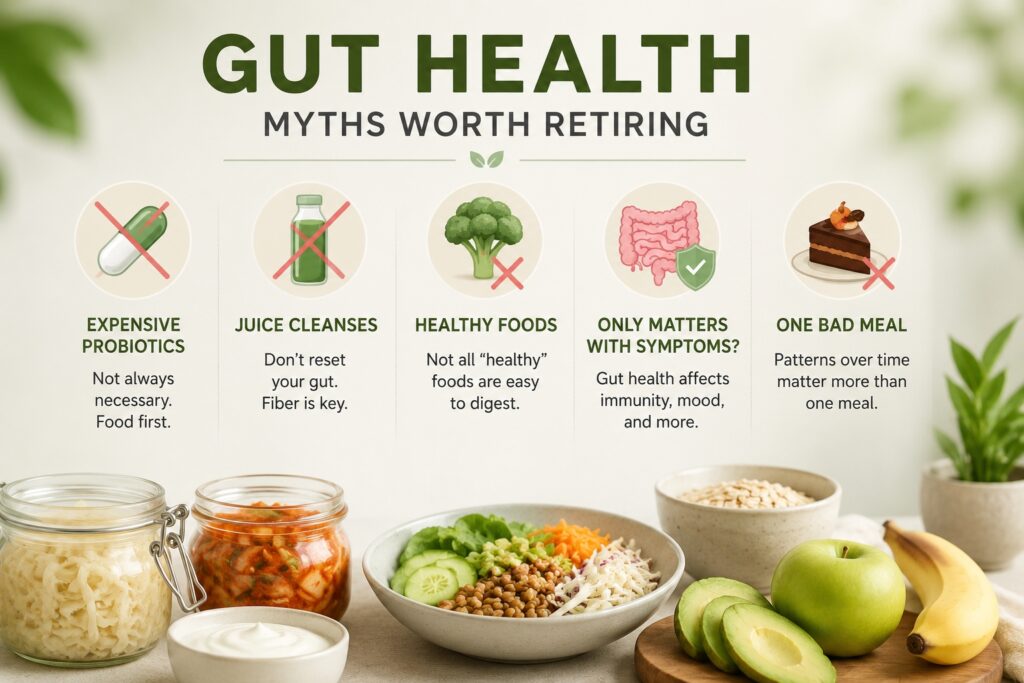
A few persistent myths make it harder to approach gut health with a level head. Clearing these up tends to save people time and money.
- “You need an expensive probiotic supplement to fix your gut.”
Fermented foods and fiber-rich meals do a lot of the same work for many people, often at a fraction of the cost.
- “A juice cleanse resets your gut.”
Removing whole foods and fiber for several days generally works against gut health rather than for it, since bacteria need fiber to thrive.
- “If a food is ‘healthy,’ it’s automatically good for your gut.”
Some genuinely nutritious foods, like raw cruciferous vegetables or certain legumes, can be hard to digest for a sensitive gut, especially in large amounts.
- “Gut health only matters if you have digestive symptoms.”
Since gut bacteria interact with immune function and mood, the case for supporting gut health holds even without obvious digestive complaints.
- “One bad meal ruins your gut health.”
A single meal rarely changes much. Gut health responds more to patterns over weeks and months than to any single choice.
How to Improve Gut Health: Foundational Habits
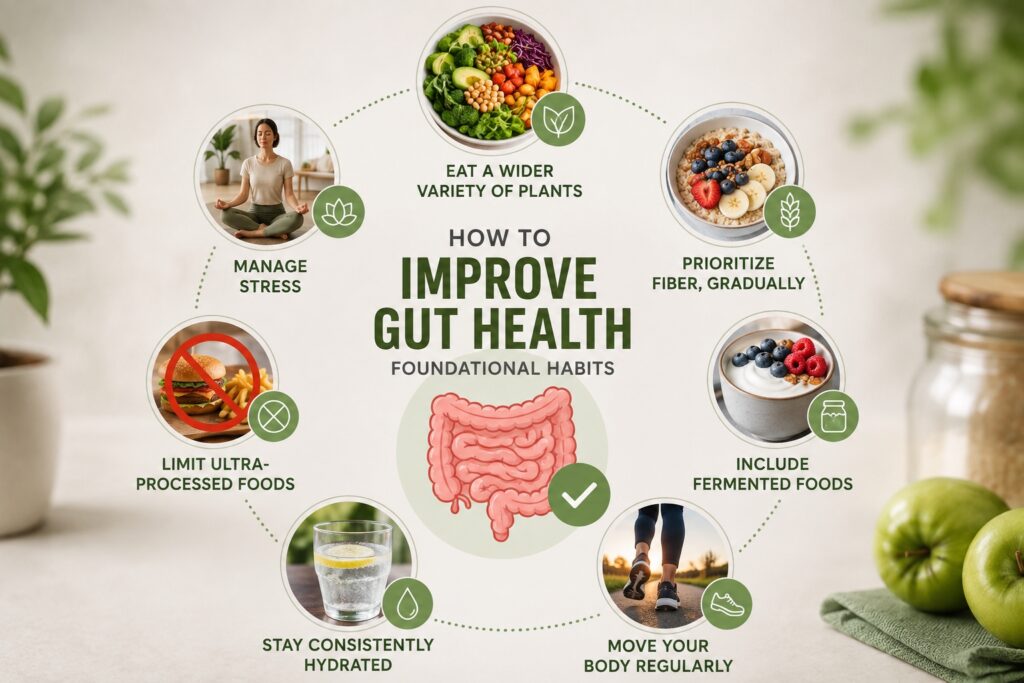
Once you have a sense of what an unhealthy gut can look like, the natural next question is how to improve gut health in a way that’s actually sustainable. The good news is that the foundational habits are fairly simple, even if they take consistency to notice a difference.
Eat a Wider Variety of Plants
Gut bacteria thrive on diversity. Eating the same five foods every week feeds a narrower range of bacteria than eating twenty different plants across a week, which is part of the thinking behind approaches like the 30 plants a week challenge that some people use as a structured way to improve gut health.
Prioritize Fiber, Gradually
Fiber feeds the beneficial bacteria in your gut, but ramping up too quickly can cause more bloating, not less. A gradual increase, spread across vegetables, fruit, legumes, and whole grains, tends to be more comfortable than an overnight overhaul.
Include Fermented Foods When You Can
Yogurt, kefir, sauerkraut, and kimchi contain live cultures that some people find helpful for digestion. Research on probiotic foods is still developing, so think of these as a helpful addition rather than a guaranteed fix.
Manage Stress Where Possible
The gut and the nervous system are closely connected, which is why stress can show up as digestive symptoms. This doesn’t mean stress alone explains every gut issue, but managing it is a reasonable piece of any plan to improve gut health.
Stay Consistently Hydrated
Water supports digestion and helps fiber do its job. Without enough fluid, a higher-fiber diet can actually worsen constipation instead of improving it.
Move Your Body Regularly
Physical activity is linked to more diverse gut bacteria in several studies, and even a daily walk appears to support regular digestion for many people.
Limit Ultra-Processed Foods When You Can
This isn’t about eliminating convenience foods entirely. It’s about noticing when heavily processed foods make up most of your diet, since they tend to be lower in the fiber and diversity that support gut health.
Taken together, these habits form the backbone of how to improve gut health without needing an extreme overhaul. Small, repeatable changes tend to stick better than a strict short-term reset.
Common Mistakes When Trying to Improve Gut Health
Even well-intentioned changes can backfire if they happen too fast or in the wrong order. These are the mistakes that come up most often.
- Adding too much fiber too quickly.
Jumping from a low-fiber diet to a high-fiber one overnight is one of the fastest ways to trigger bloating and discomfort, even though fiber itself supports gut health long-term.
- Relying on a single “superfood.”
No single food, whether it’s kombucha, kimchi, or a specific supplement, replaces the effect of overall dietary variety.
- Cutting out entire food groups without guidance.
Elimination diets can be useful diagnostic tools, but doing one without professional support often means missing nutrients or misidentifying the actual trigger.
- Ignoring hydration.
Increasing fiber without also increasing water intake is a common combination that makes constipation worse instead of better.
- Expecting immediate results.
Gut bacteria shift gradually. Judging a new habit after two or three days rarely reflects what’s actually happening.
- Skipping meals to “give the gut a break.”
Long gaps between meals can disrupt regular digestion for some people rather than helping it reset.
Should You Take a Probiotic Supplement?
Probiotic supplements are everywhere, but they aren’t automatically necessary for everyone working on gut health. Different strains are studied for different purposes, and a supplement that helps one person’s digestion may do very little for someone else.
For most people without a specific diagnosed condition, getting probiotics through fermented foods, alongside a fiber-rich diet to feed them, covers a lot of the same ground as a supplement. A probiotic supplement may be worth discussing with a doctor if you’ve recently taken antibiotics, have a diagnosed digestive condition, or haven’t seen improvement from dietary changes alone.
If you do try a supplement, look for one with a specific, named strain backed by research for your particular goal, rather than a generic blend with vague marketing claims. Give it several weeks before deciding whether it’s making a difference, since probiotics don’t tend to work immediately.
Building a Gut-Friendly Plate: A Simple Formula
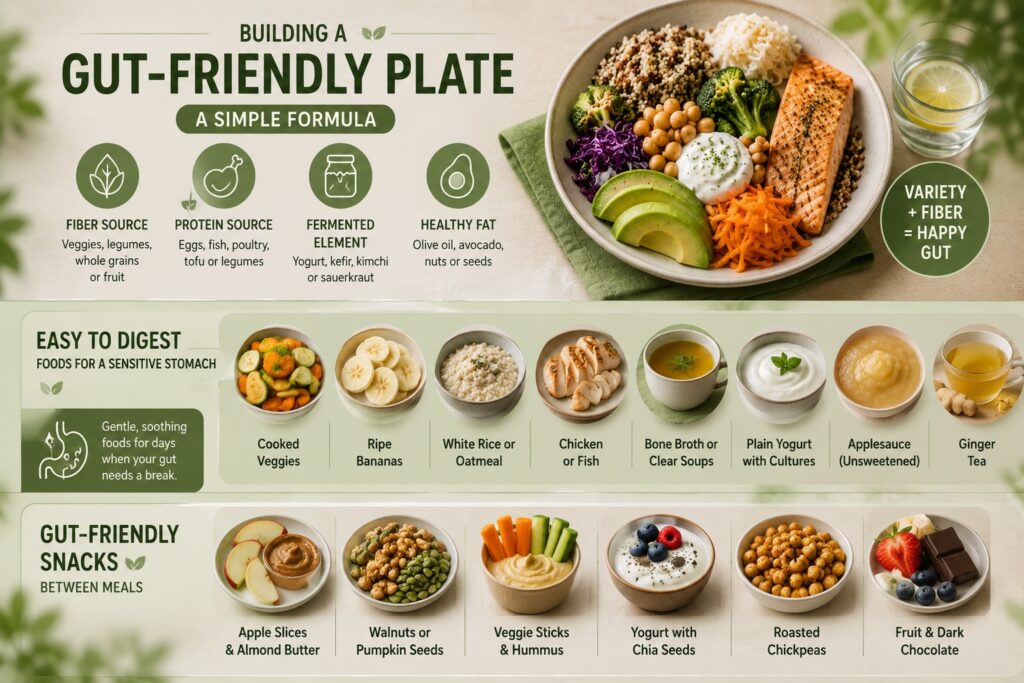
If the number of tips in this guide feels like a lot to remember, this simple formula covers most of it at a glance. Aim to build most meals around four elements:
- A fiber source. Vegetables, legumes, whole grains, or fruit.
- A protein source. Eggs, fish, poultry, tofu, or legumes double as both protein and fiber.
- A fermented or probiotic element, when convenient. Yogurt, kefir, sauerkraut, or kimchi, added a few times a week rather than every meal.
- Healthy fat. Olive oil, avocado, nuts, or seeds, which also help you absorb certain nutrients from the rest of the plate.
You don’t need to hit all four at every single meal. Over a full day or week, though, this formula naturally builds in the variety and fiber that gut health tips tend to circle back to again and again.
Easy to Digest Foods for a Sensitive Stomach
Some days, especially if you’re dealing with bloating, an active flare-up, or general sensitivity, you need foods that are gentle rather than foods that are technically “healthiest.” Knowing what foods are easy to digest can make a real difference on those days.
Easy to digest foods tend to share a few traits: they’re lower in fat, cooked rather than raw, and lower in insoluble fiber that can be harder on a sensitive gut.
- Cooked, peeled vegetables like carrots, zucchini, and squash
- Ripe bananas
- White rice or well-cooked oatmeal
- Skinless, well-cooked chicken or fish
- Bone broth or clear soups
- Plain yogurt with live cultures
- Applesauce, unsweetened
- Ginger tea, which many people find soothing for mild nausea
These easy to digest foods aren’t meant to be a permanent diet. They’re a useful, temporary toolkit for days when your system needs a break, before gradually reintroducing more variety as symptoms settle.
Gut-Friendly Snacks Between Meals
Snacking doesn’t have to work against gut health. A few simple, mostly no-prep options can fit into the same fiber-and-variety approach as full meals.
- Apple slices with a small amount of almond butter
- A small handful of walnuts or pumpkin seeds
- Carrot and cucumber sticks with hummus
- Plain yogurt with a spoon of chia seeds
- Roasted chickpeas with a pinch of cumin
- A piece of fruit paired with a few squares of dark chocolate
These snacks lean on the same fiber and fermented-food principles as the rest of this guide, just in smaller portions between meals.
Prebiotic vs Probiotic Foods: The Basics
- Two terms come up constantly in gut health conversations, and they’re easy to mix up. Probiotics are live beneficial bacteria, found in fermented foods like yogurt, kefir, and sauerkraut. Prebiotics are the fiber that feeds those bacteria, found in foods like garlic, onions, oats, and bananas.
- Think of it this way: probiotics are the seeds, and prebiotics are the soil. You generally want both, since probiotic bacteria need prebiotic fiber to actually thrive once they arrive in your gut. Most whole-food diets naturally include some of each, which is one reason variety matters more than any single “gut health food.”
High-Fiber Eating for Gut Health (Sometimes Called Fibermaxxing)
Fiber has become something of a trend recently under the term “fiber maxing,” which is really just a modern name for prioritizing high-fiber foods more intentionally. Most people fall short of recommended fiber intake, and gut bacteria rely on fiber as a primary fuel source.
A high-fiber approach to gut health usually means building meals around vegetables, legumes, whole grains, fruit, and nuts or seeds, rather than treating fiber as an afterthought. As mentioned earlier, the key is increasing fiber gradually alongside enough water, since a sudden jump can cause more bloating rather than less.
The 30 Plants a Week Approach
One popular, research-inspired approach to gut health diversity is aiming for 30 different plant foods across a week. This includes vegetables, fruits, whole grains, legumes, nuts, seeds, and even herbs and spices, since each one counts toward the total.
The idea isn’t to hit an exact number every single week. It’s a rough target that nudges you toward more variety than most people naturally get, since a typical Western diet often centers on a much smaller rotation of plant foods.
Gut Health and Bloating or IBS: A Gentle Overview
- For people managing bloating or a diagnosed condition like IBS, general gut health advice sometimes needs more nuance. High-fiber, high-FODMAP foods that work well for one person can trigger symptoms in another.
- If bloating or digestive discomfort is a regular, ongoing issue rather than an occasional one, it’s worth working with a doctor or registered dietitian, since approaches like a low-FODMAP elimination process are typically meant to be short-term and professionally guided rather than a permanent DIY diet.
A 7-Day Gut Health Meal Plan for Beginners
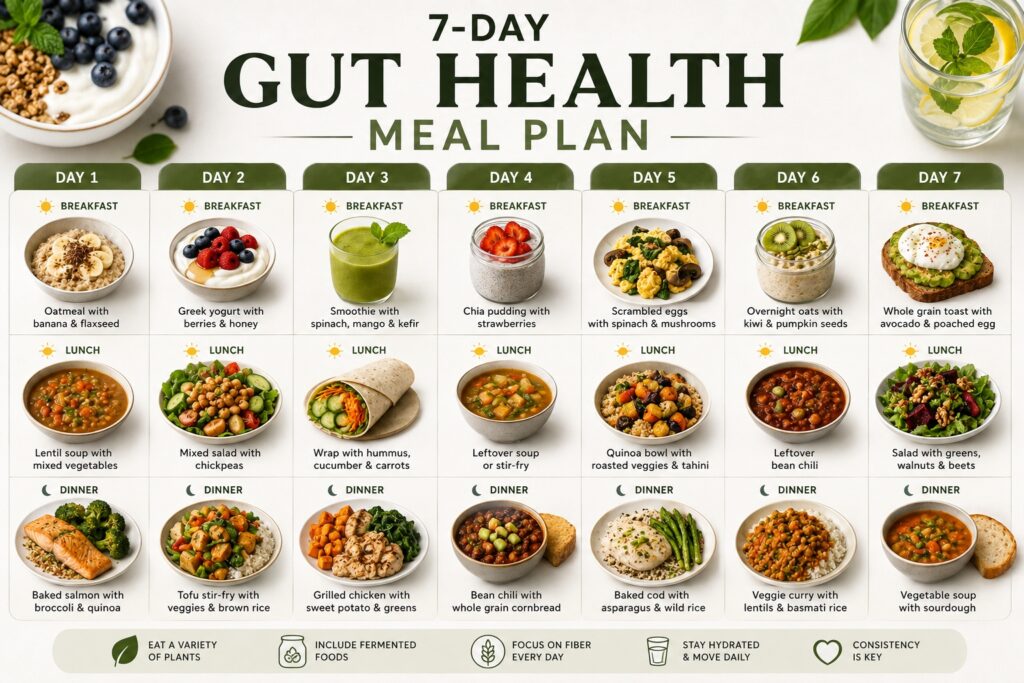
Reading about gut health tips is one thing. Putting them into practice is another. Here’s a simple seven-day framework that leans on variety, fiber, and easy to digest foods without requiring complicated recipes.
- Day 1: Oatmeal with banana and a spoon of ground flaxseed; lentil soup with mixed vegetables for lunch; baked salmon with roasted broccoli and quinoa for dinner.
- Day 2: Greek yogurt with berries and a drizzle of honey; a big mixed salad with chickpeas and olive oil dressing; stir-fried tofu with a variety of colorful vegetables over brown rice.
- Day 3: Smoothie with spinach, frozen mango, and kefir; whole grain wrap with hummus, cucumber, and shredded carrots; grilled chicken with sweet potato and sautéed greens.
- Day 4: Chia pudding with sliced strawberries; leftover soup or stir-fry from earlier in the week; bean chili with a side of cornbread made with whole grain flour.
- Day 5: Scrambled eggs with sautéed spinach and mushrooms; quinoa bowl with roasted vegetables and tahini; baked cod with steamed asparagus and wild rice.
- Day 6: Overnight oats with kiwi and pumpkin seeds; leftover bean chili; vegetable curry with lentils over basmati rice.
- Day 7: Whole grain toast with avocado and a poached egg; big salad with mixed greens, walnuts, and roasted beets; homemade vegetable soup with a side of sourdough.
This plan naturally works in fermented foods, a wide range of plants, and a steady fiber intake, without asking you to track anything or follow a rigid script. Swap meals around based on what you have, and treat this as a starting framework rather than a fixed menu.
A few notes on why this particular 7-day gut health meal plan is built the way it is: fiber sources rotate daily rather than repeating, so you’re not relying on the same one or two plants all week. Fermented foods, like yogurt and kefir, show up several times without appearing at every single meal, since variety matters more than frequency. Lean proteins are spread throughout to keep meals filling, which also tends to slow down eating and support better digestion overall.
If cooking a full week from scratch feels like a lot, batch-cook the grains, beans, and roasted vegetables on a Sunday, then mix and match them into whichever day’s meals you’re making. That single step covers most of the prep work for the entire plan.
The Gut-Brain Axis: How Gut Health Affects Mood and Sleep
- One of the more interesting areas of gut health research is the gut-brain axis, the two-way communication network between your digestive system and your nervous system. The gut produces a notable share of the body’s serotonin, a neurotransmitter linked to mood regulation, though the relationship between gut serotonin and brain mood is more complex than a simple cause-and-effect story.
- Some research suggests that gut health and sleep quality may be connected as well, though, as with much of this field, more research is still needed before drawing firm conclusions. What’s reasonably well supported is that chronic stress and poor gut health can influence each other in both directions, which is one more reason a holistic approach, rather than chasing a single fix, tends to serve people better.
- In practice, this connection shows up in fairly ordinary ways. Some people notice that a stressful week lines up with more bloating or irregular digestion, even without changing what they eat. Others find that improving sleep habits seems to coincide with steadier digestion over time. Neither observation proves a direct cause, but they’re common enough that many clinicians consider stress management and sleep part of a broader gut health conversation, not a separate topic entirely.
Gut Health and Weight Loss: What the Science Says
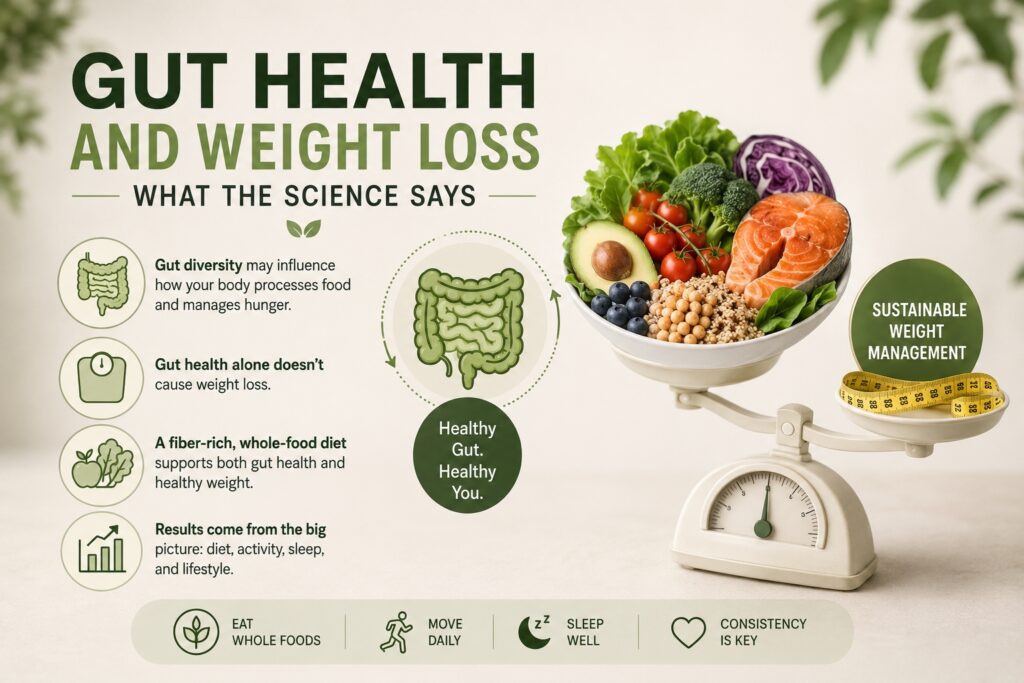
- Gut health and weight management get linked together often, sometimes with claims that overstate the current evidence. Some studies suggest that gut microbiome diversity may play a role in how the body processes food and manages hunger signals, but gut health alone doesn’t explain weight changes, and no specific food or supplement guarantees weight loss.
- If weight management is a goal, a gut-supportive diet built on fiber, whole foods, and variety can be a reasonable piece of a broader approach, alongside activity, sleep, and overall eating patterns, rather than a stand-alone solution.
- It’s also worth separating correlation from cause here. People who eat higher-fiber, more varied diets often have both healthier gut markers and steadier weight, but that doesn’t automatically mean one causes the other in isolation. Both are likely downstream of the same broader pattern: a diet built on whole, varied foods rather than one built around ultra-processed convenience options.
Gut Health Tips for Everyday Life
Beyond the foundational habits above, a few smaller gut health tips can make daily life easier without adding much effort.
- Chew food more slowly. Digestion starts in the mouth, and rushing meals can contribute to bloating.
- Keep a simple symptom log for a week or two if something feels off. Patterns are often easier to spot on paper than from memory.
- Rotate your fiber sources rather than relying on one supplement or food repeatedly.
- Avoid drinking large amounts of liquid directly with meals, which some people find helpful for reducing bloating, since it can dilute digestive processes for a portion of people.
- Get consistent sleep. Poor sleep is linked to changes in gut bacteria composition in some research.
- Limit artificial sweeteners if you notice digestive symptoms after consuming them, since some people are more sensitive than others.
None of these gut health tips are a complete solution on their own, but stacked together, they tend to support the bigger habits covered earlier in this guide.
Key Takeaways
- Gut health refers to the balance of bacteria and overall function of your digestive system, not a single measurable number.
- The 10 signs of an unhealthy gut include bloating, irregular bowel habits, fatigue, and skin issues, among others, though none are diagnostic alone.
- Knowing what foods are easy to digest, like cooked vegetables, rice, and ripe bananas, helps on days when your system needs a break.
- A 7-day gut health meal plan built on variety, fiber, and fermented foods is a practical way to start.
- Persistent or severe symptoms should always be discussed with a doctor rather than addressed through diet changes alone.
Frequently Asked Questions
- How long does it take to improve gut health?
There’s no fixed timeline, since it depends on the individual and what’s driving the imbalance. Many people report noticing some digestive changes within a few weeks of consistent habits, though meaningful shifts in the gut microbiome can take longer.
- What are the clearest signs of an unhealthy gut?
Frequent bloating, irregular bowel habits, and persistent fatigue are among the most commonly reported signs of an unhealthy gut, though these can also stem from other causes, which is why persistent symptoms deserve a medical opinion.
- What foods are easy to digest during a flare-up?
Cooked and peeled vegetables, ripe bananas, white rice, and plain yogurt are generally considered easy to digest foods, especially compared to raw vegetables, beans, or heavily fried foods during a sensitive period.
- Can improving gut health help with weight loss?
It may play a supporting role for some people, since fiber and whole foods that support gut health also tend to support fullness and steadier digestion, but gut health alone isn’t a guaranteed weight-loss strategy.
- Are probiotic supplements necessary for gut health?
Not necessarily. Many people support gut health through fermented foods and a fiber-rich diet without supplements, though a doctor or dietitian can advise on whether a specific probiotic supplement makes sense for your situation.
- Is bloating always a sign of an unhealthy gut?
Not always. Occasional bloating after a large or unusually rich meal is common and not necessarily a sign of an unhealthy gut on its own. It’s the frequency and pattern that matter more than any single instance.
- Can children and older adults follow the same gut health tips?
The general principles, like variety, fiber, and fermented foods, apply broadly, but specific amounts and any supplement use should be adjusted for age and individual health needs, ideally with guidance from a pediatrician or your family doctor.
Conclusion
Gut health isn’t a single habit or a single food. It’s the sum of small, repeatable choices: eating a wider variety of plants, prioritizing fiber gradually, including fermented foods, managing stress, and paying attention to how your body responds along the way.
If you’ve made it this far, you already have the foundation: what gut health means, the signs of an unhealthy gut worth watching for, which foods are easy to digest on harder days, and a 7-day plan to put it into practice. From here, explore the deeper dives on our gut health category page on The Daily Crave (thedailycrave.online), covering everything from the gut-brain connection to high-fiber eating in more detail.